There is a particular satisfaction that comes from writing a word with confidence, and there is an even greater satisfaction that comes from discovering a word you do not know and learning how to own it. The Spelling Test App brings that experience to life with a simple idea and a supportive environment. It exists to help learners improve their spelling, expand their vocabulary, and refine their ear for pronunciation. What makes it especially interesting is its Australian focus.

It uses Australian English word lists, pronunciation cues, and conventions that align closely with British usage while still reflecting local character. This matters for anyone preparing for study, professional communication, or personal growth within contexts where British and Australian standards rule. The design of the site feels direct and unpretentious, which for a learning tool is exactly what you want. It does not distract with unnecessary ornament, and it brings forward features that address common stumbling blocks in spelling. Audio support lets you hear words clearly. Definitions and example sentences provide semantic anchors. Customisation options offer a range of word counts and timing structures. Levels span from school years through to adult. With these elements, the app invites a practical approach to learning that favours informed repetition and thoughtful review.

An Australian Based Approach With British Relevance
Australian English shares much with British English, and for spelling practice this alignment is valuable. If your daily work or studies are tied to British norms, Australian lists will feel comfortably familiar. You encounter forms such as organise, recognise, and analyse. You will see colour, labour, and favour. You will see centre rather than center, jewellery rather than jewelry, and catalogue rather than catalog. These conventions matter beyond tests. They shape the tone of official communication, academic writing, journalism, and professional documents across many sectors. The app’s word sets respect these standards. That makes it suitable for learners in Britain, Australia, New Zealand, and other places where these norms prevail.
There is another dimension to the Australian focus. Pronunciation carries local accent cues that still remain understandable and clear for British users. When you practise with a calm, precise voice that renders syllables distinctly, you gain listening skills that transfer across accents. The app offers repeated playback and this is essential because unfamiliar words often require more than one listen. It is easy to mix up subtle vowel sounds or consonant clusters. Hearing a word several times supports careful segmentation, and when you combine that with an example sentence, you get context that reinforces meaning and suggests spelling patterns. This blend of audio and semantic support is thoughtfully done and helps you turn tricky words into stable knowledge.
Audio Support That Serves the Learner
Audio is the heart of a spelling test. If you cannot hear a word clearly, the rest of the task becomes guesswork. The Spelling Test App offers clean pronunciation and provides a set of companion tools around that audio. You can press a button to repeat the word as many times as you need. You can request the definition. You can view an example sentence. These aids are not crutches. They are part of a sound learning philosophy. When you know the meaning and eye an example, you anchor the sound to a mental picture. That image can help you recall the letters. Consider the difference between hearing a rare word in isolation versus hearing it in a sentence where the situation makes sense. In the second case you can often infer the correct root and suffix by recognising the family to which the word belongs. Definitions narrow the field, which reduces random guessing. Example sentences provide cues about tone and typical usage, which support memory retention through association.
Headphones or speakers are important here. The app reminds you to use them before you start. A quiet environment matters too. Many words that challenge adult learners have subtle shifts in vowel quality or consonant placement. Words like obfuscate or pernicious can surprise you with their internal structure. If you listen with attention and repeat the audio while focusing on syllable boundaries, the chance of accurate spelling rises sharply. Over time, this practice builds a habit of careful listening that will serve you well beyond the app.
Levels From School Years to Adult
The app offers a range of levels, each aligned to educational stages. That progression lets you find your footing and move forward in a sensible way. For younger learners in early school years, the words tend to be high frequency, everyday vocabulary that reinforces classroom learning. As the levels rise, complexity increases. Words include more varied roots and affixes, longer syllable chains, and more abstract meanings. The adult level focuses on advanced vocabulary, often drawn from academic, legal, literary, and scientific domains. This is where you meet terms that sharpen professional writing and enrich reading. The presence of multiple levels also allows mixed ability groups to use the same tool with different settings. A teacher might set Year Six words for one group while another group explores the adult list. A family might use school levels for children and adult lists for parents who want to refresh their spelling and vocabulary with a purposeful challenge.
Customisation and Timer Options
Customisation matters because learning is personal. The app lets you select the number of words in a test and choose whether to run with a timer or without one. If you are new to advanced vocabulary, start small. Five words without a timer allows time to listen, reflect, and apply strategies. As you gain comfort, increase the word count. When you feel confident with your process, introduce a timer to simulate exam pressure or work deadlines. Time constraints change the task. They encourage quick segmentation, prompt recall of known patterns, and discourage unnecessary hesitations. If a timer feels intimidating, consider a gentle approach. Use a generous limit to start, then reduce the limit as your skill improves. This way you build fluency without anxiety. The key is to treat the timer as a training tool rather than a test of worth. The app presents these options clearly, which gives you control over your learning experience.

A Hands On Walkthrough of the Adult Level
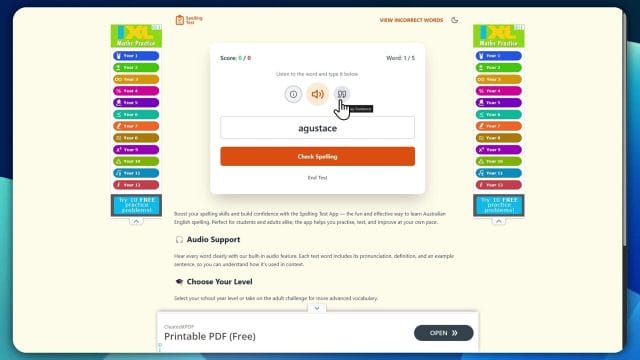
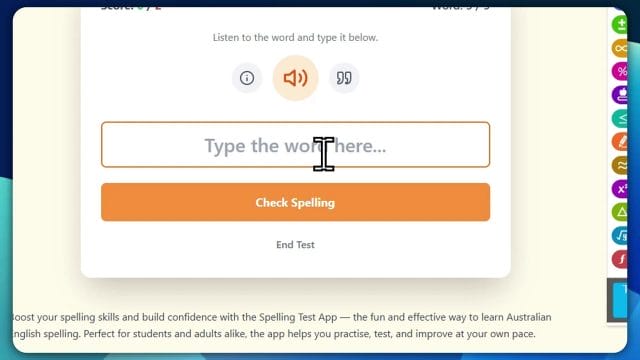
To understand how the app feels in practice, we can walk through a small test. The adult level invites substantial vocabulary. Selecting five words without a timer provides space to explore without pressure. Before beginning, the app reminds you to have speakers or a headset ready. Good advice. A strong audio experience avoids misunderstandings that lead to false errors. With the environment prepared, tap the start button and meet the first challenge. The words appear one at a time, presented by audio with support for definition and sentence. The experience is direct and focused. There is a sense of curiosity that comes from hearing a word you do not often write. That feeling is valuable because it drives engagement. A spelling test should not be joyless. It should invite you to play with sounds, meanings, and patterns.
Obfuscate
The first word is obfuscate. It arrives with a steady voice, and you recognise that it belongs to formal discourse. If you have not written it often, it can feel slippery. The app offers a definition. To render something obscure, unclear, or unintelligible. It offers a terse example. The lawyer’s deliberate use of legalese served only to obfuscate the simple facts of the case. This context places the word firmly in legal and rhetorical terrain. The sound breaks down as ob fu scate. The prefix ob signals toward or against. The element fusc relates to dark or dusky. The ending ate is a common verbal suffix. When you listen carefully, the consonant sequence fusc compresses with the s and the c forming a soft s sound. A frequent trap is to misplace a letter within this cluster. One might insert an extra vowel or soften the sequence incorrectly. Another trap is to reach for obscure as a base and add ate without the fusc, which produces an incorrect form.
To spell it accurately, imagine a dim corridor of legal language where the light refuses to reach the facts. In that corridor, the fusc element acts like a veil. Ob directs you into the veil, and ate completes the action. Write the letters in order while repeating the syllables under your breath. Ob. Fusc. Ate. If you need another approach, think of other words that share the fusc element, such as infuscate, a rare term meaning to darken. The root pattern becomes familiar, and you can carry it into obfuscate. Listen again. Press the repeat button. Pay attention to the relationship between the b and the f. They do not blur. There is a clean break. Finally, test your confidence by visualising the example sentence. The lawyer’s choice to use complex jargon has a purpose. In that choice lies the act described by obfuscate. With meaning secured, the letters flow more naturally.
Pernicious
The second word is pernicious. The definition tells you that it refers to something that has a harmful effect, especially in a gradual or subtle way. The example sentence carries a political tone. The pernicious rumours slowly eroded the candidate’s public image despite their lack of verifiable truth. The sound pattern here is per ni cious. The meaning’s subtlety aligns with slow erosion, which suggests long term damage rather than a sudden blow. If you love etymology, this is helpful. The per element can suggest thoroughness, and the nic root connects historically to harm. In modern usage, the word functions well in writing that critiques policies, ideologies, narratives, and social behaviours that cause damage over time.
Common errors with pernicious include misplacing the i, turning it into pernicious with a different vowel pattern, or adding an extra consonant. Another trap lies in the cious ending. Learners sometimes attempt a sh sound with different letter combinations. Remember that c followed by i can produce the soft sound. Cious is a familiar ending in other words such as suspicious, spacious, and malicious. Once you recognise the pattern, the sound to letter mapping becomes less mysterious. A memory aid can help. Picture a slow drip of corrosive liquid wearing away stone. That image stands for pernicious influence. Pair that image with the cious ending. Your mind begins to mesh the sound and the pattern, which supports recall. In usage, pernicious often modifies intangible forces, such as beliefs, habits, or rumours. Connect that nuance to your spelling practice and you will retain the letters more reliably.
Mellifluous
The third word is mellifluous. It arrives with a lyrical quality in its sound and meaning. Mellifluous describes something that is sweet sounding, smooth, and pleasing to the ear. The structure breaks down as mel li flu ous. Etymology again helps. Mel relates to honey. Flu ties to flow. The image of honey flowing gives you a direct path to memory. When a voice is mellifluous, it pours like a stream of honey. The biggest traps are missing an l, dropping the second vowel, or warping the flow by inserting an extra letter in the flu sequence. Another misstep is to confuse the term with mellifluent, a rare variant, or with melodious, which belongs to a different family but shares a general tone of musical sweetness.
To spell mellifluous confidently, anchor yourself in the twin elements mel and flu. Double the l after mel to capture the liquid quality in the sound. Flu remains a familiar root from words such as influence and fluent. The ous ending belongs to a large class of adjectives. Write the word slowly while hearing a singer whose voice glides without friction. If you need an exercise, recite a line of poetry that flows with grace and attach the word to that memory. In everyday writing, mellifluous is more at home in literary criticism, music reviews, or descriptive passages that value sensory detail. However, it is a delightful word to own for personal writing too. Practice will prevent common misspellings such as melifluous or mellifluous with the vowels scrambled. Listen to the audio several times. Feel the rise and fall of syllables. Let the honey image guide you through the letter sequence.
Sagacious
The fourth word is sagacious. The definition offers a familiar sense of wisdom and keen judgement. Someone sagacious sees patterns truly and decides well. The sound sequence is sa ga cious. An easy error is to add an extra t, forming a wrong variant such as sagatious, likely arising from the influence of words like cautious or ostentatious. Another error is to replace the g sound with a j like sound in the letters, which confuses the pattern. If you rely on meaning, you will find support. The root connects to keen perception. The cious ending once again invites the pattern you saw in pernicious. Pairing the words in memory can help. Pernicious and sagacious share the cious ending but live in different evaluative fields. One describes harmful influence while the other praises wisdom.
Write sagacious with a calm rhythm. Sa. Ga. Cious. If you need reinforcement, think of a sagacious advisor who sees through illusions. Imagine a scene where that person calmly offers counsel in a difficult situation. Attach the letters to the image. There is a validity in narrative memory for spelling. When a word carries a narrative, you can revisit the scene whenever you need to recall the letters. In formal writing, sagacious can replace phrases such as very wise or deeply insightful. It brings a fine register that suits essays, reviews, and public commentary. Practise by writing a short sentence that uses the word in a rich context. Confidence comes with repeated use.
Cacophony
The fifth word is cacophony. The sound name itself suggests a noisy clash. Cacophony describes harsh, discordant sounds. The syllables break down as ca co pho ny. The element pho points to sound and appears in other words such as symphony, microphone, and phonetic. The ca co pair relates to bad or harsh qualities. Common mistakes include writing cacaphony with an extra a, or misplacing the o in the second syllable. Another frequent error is to soften ph incorrectly or to confuse the ny ending with a different vowel pattern.
When you hear the audio, picture a crowded street with clashing horns, shouting voices, and metallic rattles. That scene is a living illustration of cacophony. The ph sequence signals the f sound while preserving the historical link to Greek roots. Once you attach the scene and the ph pattern in your mind, the spelling becomes more stable. After several listens, write the word while repeating ca co pho ny quietly. If you prefer a second approach, link cacophony with symphony as opposites. Symphonic order contrasts with cacophonous chaos. Use the pair to hold the letters in place. In writing, cacophony works beautifully in descriptive passages, essays on sound design, or social commentary where the clash of voices or messages undermines calm discourse.
Checking Spelling and Receiving Feedback
After writing each word, you press the button to check the spelling. If you have made an error, the app tells you. This is where the feedback loop becomes powerful. It does not scold. It simply presents correct forms and lets you absorb them. At the end of the sequence, the app shows you the words again with their proper spellings. It reminds you of your accuracy and offers options to try again, or to explore different levels. There is real learning value in this moment. When you compare your attempt with the correct form, your mind registers the difference. If you take a moment to reflect on why you made the error, you can extract a rule or pattern to carry forward. In our small test, the adult words were unforgiving. Obfuscate can catch even experienced writers. Pernicious demands attention to vowel and ending. Mellifluous punishes haste. Sagacious asks for restraint and clarity. Cacophony needs an honest ear for ph and vowel placement.
The emotional component matters too. If you get multiple words wrong, it is easy to feel discouraged. Resist that. Look at the structure of what happened. You got the meaning. You engaged with the audio. You attempted complex words under test conditions. That is valuable practice. The gain comes from repetition across sessions, not from a single perfect run. The app facilitates this by making it easy to retake the test and vary settings. In time, your accuracy rises. More importantly, your confidence grows. You begin to recognise patterns across words and rely less on guesswork. That shift is the goal of intelligent spelling practice.
Accuracy Reports and the Incorrect Word List
The app presents accuracy statistics at the end of a test. It shows a percentage based on your correct entries. This immediate measure offers a sense of where you stand. However, the more interesting feature is the incorrect word list. This is a compilation of words that users struggle with across the platform. When you examine this list, you discover patterns. Certain endings cause trouble. Certain roots confuse. Words with silent letters or unusual consonant clusters rise to the top. This crowd sourced difficulty index is a treasure trove for study planning. If you want to make efficient progress, target clusters of words that share the same challenging feature. For example, words with the cious ending present a neat mini curriculum. Words with ph for the f sound present another. Words with Latin or Greek roots that feel opaque present another.
Use the list as a guide. Pick ten words from a difficulty cluster and focus on them for a week. Listen to each word. Write the definition by hand. Compose a sentence that feels natural. Spell the word three times in a row. The repetition anchors the pattern. Return to the same set two days later and review. You will feel the letters settling into place. The incorrect word list connects personal learning with community data. You stand to benefit from patterns revealed by many learners. That is the beauty of a shared platform.
Building a Method That Works With the App
A good app can support your learning. A method can transform it. The Spelling Test App provides tools and structure. You can use them to build a personal routine that respects how you learn and leads to consistent improvement. Think of this as a craft. Listening becomes an art. Writing becomes a mindful practice. Review becomes a habit. With these elements, spelling moves from a test of memory to a growth activity.
Prepare Your Environment
Before you begin, set yourself up for success. Use headphones or a reliable set of speakers. Sit in a comfortable, quiet place. Have a notebook beside you. Writing by hand helps retention. You can note definitions, syllable breakdowns, and example sentences as you listen. If you study at a desk, remove clutter that distracts the mind. Keep water nearby. Plan a short break after fifteen minutes to refresh attention. These small choices affect performance. When your environment is peaceful, you listen better. When you listen better, you spell better.
Tune Your Listening
Listening is not passive. It demands attention to detail. When you hear a word, focus on syllable boundaries. Identify stress. Ask yourself where the sound heightens and where it relaxes. With obfuscate, the stress sits closer to the first syllable. With pernicious, the stress falls on the second syllable. With mellifluous, the rhythm flows across the middle. With sagacious, a gentle stress sits on ga. With cacophony, the stress lands on co. These details guide your mapping from sound to letters. When you press repeat, aim to hear one new detail each time. On the first listen, capture syllables. On the second, capture consonant clusters. On the third, capture vowel quality. Appeal to the definition when sound alone feels uncertain. The meaning offers clues. A word that means sweet sounding will rarely use harsh letter combinations. A word that means harsh or jarring will likely include sharp consonants.
Use Definitions and Example Sentences Effectively
Definitions are not mere decorations in a spelling exercise. They are keys to the vault. When you read a definition, ask what family the word belongs to. Does it describe a sound, a behaviour, a judgement, a process. Family affiliation reveals typical suffixes and roots. For example, adjectives that carry a cious ending often relate to qualities, both positive and negative. Words that describe actions frequently end with ate. Words that describe sounds often involve pho or phon. Example sentences help you feel the register. Is the word formal, informal, technical, poetic. If the register is formal, the spelling will likely reflect classical roots. If the register is technical, expect standardised forms linked to a discipline. Attach a small story to the sentence. For obfuscate, imagine a barrister who buries a simple truth under layers of jargon. For pernicious, see a rumour spreading slowly through a crowd. For mellifluous, hear a voice at twilight. For sagacious, meet an elder who offers calm insight. For cacophony, walk through a market at midday. These scenes give you hooks to hang the letters on.
Manage Time Pressure Thoughtfully
A timer can be a friend or an adversary. In learning, it should be a friend. Start without a timer. Focus on process. Once you have a rhythm for listening and writing, introduce a gentle time limit. Use it to banish dithering, not to invite panic. If you feel anxious, enlarge the limit again. The app gives you control over this. You can select specific timers and adjust them session by session. Over weeks, you will find that a reasonable time constraint improves fluency. It teaches you to trust patterns and commit to an answer without getting stuck in hesitation. That skill transfers to exam situations and professional tasks. The aim is to combine accuracy with speed through practice, not through pressure.
Select Levels and Words Strategically
At the start, choose a level that matches your current comfort. If adult vocabulary feels intimidating, drop to a high school year that offers challenge without overload. Customise word count. Five words are perfect for focused attention. Ten words offer variety. Keep sessions short and regular. If you complete one five word set in the morning and another in the evening, the repetition across the day aids consolidation. As you improve, move up levels slowly. Do not rush. Mastery comes from deep familiarity with patterns and roots, not from skimming across lists. The app’s level structure helps you pace yourself without losing sight of the horizon.
Review and Consolidate After Each Test
When a test ends, resist the urge to move on immediately. Study the final screen. Copy the correct spellings for any words you missed. Note the syllable pattern. Write the definition again. Compose your own example sentence. Then enter the word into a personal list that you revisit the next day, two days later, and a week later. This is spaced repetition. It leverages how memory works. You refresh the pattern before it fades, and each refresh strengthens the link. If you like digital tools, store your list in a flashcard app that supports spaced scheduling. If you prefer paper, keep a small notebook for your spelling practice. Either way, the point is to bring deliberate focus to review rather than rely on a single exposure.
Work With the Incorrect Word List
Spend time with the app’s incorrect word list. It can inspire and guide your study. Approach it in two ways. First, scan for patterns that match your weaknesses. If cious endings appear often in the list and you struggled with pernicious and sagacious, build a mini study unit on cious adjectives. Second, use the list to discover new words beyond your current level. Advanced words expand your reading and writing more than common ones. The list gives you a curated pool of challenges that the community finds hard. That means you can be confident that studying these words offers a good return on effort.
As you work with the list, keep records. Note which words you have mastered and which remain stubborn. Make a plan for stubborn words. Increase exposure. Write the word daily for a week. Use the word in conversation deliberately. Place it into short journal entries. When you encounter the word organically in reading, pause and savour it. The more places you meet a word, the stronger the memory. Over months, this focus on the incorrect list will transform your spelling decisively.
Reflections on Pedagogy and Design
An app can reveal its educational philosophy through small design choices. The Spelling Test App signals respect for learners. It provides audio that is clear and repeatable. It offers meaning alongside sound. It invites practice across levels. It shows mistakes without drama. These elements align with what modern cognitive science knows about effective learning.
Multimodal Learning
Learning improves when you engage multiple pathways. In spelling, audio and semantics are the key partners. Hearing the word activates auditory processing. Reading the definition activates semantic networks. Seeing and writing letters activates visual and motor systems. When these systems work together, memory consolidates more robustly. Think of the app’s trio of audio, definition, and sentence as a deliberate multimodal arrangement. Each mode reinforces the others. Because of this, even learners who struggle with pure memorisation can succeed by building meaning and context around the sound.
Error Driven Learning
There is a concept called desirable difficulty. It suggests that tasks that are challenging but achievable produce better learning than tasks that are too easy. Errors become opportunities. The app’s advanced adult words create desirable difficulty. When you get a word wrong, you do not fail. You receive critical information about a pattern that was not yet stable. The immediate presentation of the correct form allows you to compare your attempt and adjust. Over sessions, these small corrections build broad competence. The incorrect word list extends this by revealing common traps. That shared data supports targeted effort. If you embrace errors as feedback, the app becomes more than a test. It becomes a workshop.
Adult Learners and Advanced Vocabulary
Adult learners often bring a rich mental library of words they recognise but do not write often. In professions like law, medicine, academia, journalism, and public policy, precise vocabulary is a tool and a sign of expertise. Words like obfuscate, pernicious, mellifluous, sagacious, and cacophony are not daily in casual conversation, but they appear in reading and formal writing. Practising them repairs gaps between recognition and production. Another benefit is that advanced vocabulary sharpens nuance. You can say a thing is harmful. You can also say it is pernicious, which communicates a slower, subtler kind of harm. You can say a sound is rough. You can also call it a cacophony, which conveys a textured clash. The app’s adult level invites this refinement in your expressive ability. That is a skill worth the effort.
Australian English Focus With UK Value
While the app’s origin is Australian, its value translates directly for British users. Spelling conventions align well. Pronunciation is clear and accessible. The cultural references in example sentences are broad. This makes the app a suitable platform for learners across the British Isles and Commonwealth contexts. For those who write within British standards, it is reassuring that the spellings you practise will match your professional needs. If you encounter a minor variation between Australian and British usage, treat it as an opportunity to deepen your knowledge of English’s diverse traditions. In practice, the overlap is significant enough to make this tool feel native to British learners.
Practical Strategies for Tricky Words
Spelling success with advanced words often depends on technique as much as exposure. Below are practical strategies that you can apply to any word you encounter in the app, and you can test them with the five words from our walkthrough.
Learn High Value Roots and Suffixes
English draws heavily from Latin and Greek. Many advanced words consist of a core root or two, plus common suffixes. If you learn these elements, you gain leverage across many words. Consider the following collection of high value pieces that appeared in our test.
- Ob, a prefix that suggests toward or against, seen in obfuscate.
- Fusc, a root that connects to dark or obscure qualities, seen in obfuscate.
- Ate, a common verb ending that marks action, seen in obfuscate.
- Per, a prefix suggesting thoroughness, seen in pernicious.
- Nic, a root that connects to harm, seen in pernicious.
- Cious, an adjective ending that appears in numerous words, seen in pernicious and sagacious.
- Mel, a root linked to honey, seen in mellifluous.
- Flu, a root related to flow, seen in mellifluous.
- Sag, a root linked to keen perception, seen in sagacious.
- Caco, a root connected to bad or harsh qualities, seen in cacophony.
- Phon, a root related to sound, seen in cacophony.
When you meet a new word, ask which of these families it might belong to. If the meaning relates to sound, search for phon. If the meaning relates to sweetness or smoothness, search for mel and flu. This approach is not foolproof, but it reduces cognitive load. Your mind stops treating every word as unknown and begins to parse them into known pieces. That shift accelerates learning.
Segment Syllables Deliberately
Syllable segmentation may sound basic, but it is the backbone of reliable spelling. Take each word and break it into parts that you can hold in working memory. With obfuscate, you might write ob fusc ate on your paper before combining. With pernicious, write per ni cious. With mellifluous, write mel li flu ous. With sagacious, write sa ga cious. With cacophony, write ca co pho ny. In each case, the segments are manageable. You can spell within each segment and then connect them. This method helps prevent skipping letters or scrambling vowels under pressure. Pair segmentation with repeated audio to verify that your chosen breaks align with natural stress. Over time, your segmentation becomes instinctive.
Map Sounds to Letters With Care in British and Australian Usage
Certain sound to letter mappings recur in British and Australian English. Ph often maps to the f sound. C followed by i often maps to a soft s sound. The cious ending is a frequent pattern in adjectives. G can carry a hard g sound before a, o, and u. Recognising these rules helps you navigate unfamiliar words. In cacophony, the ph is non negotiable. In pernicious and sagacious, the cious ending stabilises the spelling. In mellifluous, the double l reflects the mel root strongly and supports the flow. In obfuscate, the fusc cluster is rare but logical once you know the fusc element. Listening will confirm where to apply these rules. Reading definitions and sentences will confirm whether the word belongs to the sound family you think it does.
Create Memory Palaces and Imagery
If you enjoy creative techniques, build memory palaces or imagery routines around words. A memory palace is a familiar place in your mind where you store images that represent ideas. For obfuscate, imagine a dim library corridor in a courthouse where paperwork piles block clear view. Place this image near the entry vestibule. For pernicious, imagine a slow leak in a stone fountain that stains the basin over months. Place this image in the garden. For mellifluous, imagine a singer by a window at dusk pouring honey into a teacup while singing softly. Place this image in the kitchen. For sagacious, imagine a wise friend at the study table pointing at a map with a calm hand. Place this image in the study. For cacophony, imagine a chaotic street with tin drums and clashing horns. Place this image outside near the gate. When you need to recall a spelling, walk through your palace and retrieve the image, then extract the letters from the symbols you embedded in each scene.
Anticipate Common Traps Revealed by the Incorrect List
The incorrect word list acts as a map of common traps. Here are the types of traps to watch for, each illustrated by the sample words.
- Consonant clusters that hide letters, such as the fusc in obfuscate. Do not add extra vowels to break the cluster unless the sound demands it.
- Adjective endings that attract errors, such as cious. Study the pattern across words and repeat it in your writing.
- Double letters that indicate roots, such as the double l in mellifluous. Do not drop a letter when you feel the flow of the word.
- Greek derived sound patterns that use ph for f, such as cacophony. Respect the classical mapping even when your ear might suggest a simpler f.
- Confusions with similarly sounding words, such as sagacious near cautious. Keep the base meaning and root identity firmly in mind.
By bringing these traps into conscious awareness, you not only avoid errors but also build a toolkit that works across many words. This awareness changes spelling from a blind recall task into a skilled analysis process.
Deep Practice With the App’s Features
What sets this app apart is the synergy of features around a simple spelling test. To realise full value, treat each feature as a lever for deeper practice.
Repeat Audio With Purpose
When you press repeat, do not merely hear the same sound again. Set micro goals for each listen. First, capture basic syllable count. Second, capture stress. Third, capture consonants. Fourth, capture vowel qualities. Fifth, capture rhythm. This structured listening builds a kind of mental transcript of the sound. It prevents the common mistake of listening repeatedly without focus. Three to five repeats, each with a target, can outperform ten repeats with no target.
Use Definitions to Connect to Families
Definitions invite family identification. If the word involves harm, search your memory for other words in the harm family. Malicious, malevolent, pernicious. If the word involves sound, collect words in the sound family. Symphony, cacophony, euphony, phonetics. If the word involves wisdom, collect words in the judgement family. Sagacious, judicious, perspicacious. These families share suffixes and roots. Practising within a family across sessions creates repeating structures in memory. When a new word arrives, your mind scans these structures and proposes likely letter patterns. This is how advanced learners spell with confidence across unfamiliar territory.
Craft Personal Example Sentences
After reading the app’s example sentence, write your own. For obfuscate, you might write, The consultant’s report used ornate language that did little more than obfuscate the core recommendation. For pernicious, you might write, A pernicious culture of blame slowly undermined trust within the team. For mellifluous, you might write, The presenter’s mellifluous tone soothed the audience after a tense discussion. For sagacious, you might write, Her sagacious decision to pause and gather more evidence saved the project. For cacophony, you might write, The station’s announcement speakers created a cacophony that drowned out all clarity. Writing these sentences engages creative and critical faculties. The act of composition reinforces spelling through meaningful use.
Plan Sessions and Track Progress
Consider the app as part of a weekly routine. Create a simple plan. On Monday, run two five word tests at a comfortable level without a timer. On Wednesday, run two five word tests with a gentle timer. On Friday, run one ten word test with a timer and one without, then review the incorrect list for patterns. Record your accuracy each time. Note two words that felt hard and add them to your personal review list. Over a month, your notebook will reveal progress clearly. The rhythm of sessions builds familiarity and reduces anxiety. The modest frequency prevents burnout. The record creates accountability for your own growth.
Lean on the Community’s Difficulty Data
Use the incorrect word list as a curriculum engine. Every week, choose a theme derived from recurring difficulties. One week might be cious adjectives. Another week might be ph sound words. Another week might be words with Latin roots you find opaque. Structure your test choices around that theme. This targeted approach yields faster improvement than random selection. It also brings variety and focus together, which keeps practice engaging without becoming overwhelming.
Why This App Is Useful for Serious Learners
Beyond the immediate experience of taking a test and checking spelling, the app provides a mature platform for sustained development. It supports learners who value precise language. It accommodates growth from early school years to adult mastery. It treats errors as informative events. It balances audio clarity with semantic depth. It offers a clean interface that keeps you focused on learning rather than on navigating complicated menus.
For students preparing for exams, the app enhances listening accuracy and spelling practice within relevant standards. For professionals, it refreshes vocabulary and strengthens written communication. For writers and editors, it sharpens attention to letter patterns and their historical logic. For those who simply enjoy words, it opens doors to pleasures of refined language and sound. Combine these strengths with a personal method and you have a foundation for real progress.
From First Try to Ongoing Mastery
Your first run may feel humbling, especially at the adult level. That is fine. The challenge exists to push you forward. You heard obfuscate and felt uncertain. You read the definition and formed a picture. You wrote your best attempt and checked. You discovered an error. Then you learned. The same pattern applies across pernicious, mellifluous, sagacious, and cacophony. Each word becomes a mentor pointing out where you can improve. If you adopt a growth mindset and return the next day, you will find that yesterday’s obstacles have softened. With each loop through the test, more words become familiar friends. At that point, the timer becomes a tool for fluency. The incorrect list becomes a map of the frontier. The audio buttons become instruments in a practice room.
Language learning thrives on curiosity. Use this app as an invitation to explore beyond the words you meet in tests. When you encounter obfuscate, go searching for clarifying verbs that represent the opposite. When you lock in pernicious, list antithetical adjectives such as beneficial and salutary. When you live with mellifluous, explore rough and grating words to widen your descriptive range. When you understand sagacious, pair it with terms that examine wisdom from other angles. When you embrace cacophony, seek out euphony and harmony as balancing ideas. This comparative exploration strengthens your semantic web and, by extension, your spelling accuracy.
Closing Reflections on Using the App Well
The Spelling Test App offers a simple surface and a deep well of practice. Its Australian base makes it naturally suitable for British learners. Its audio and definitions combine to support both recognition and production. Its levels allow gentle entry and robust challenge. Its timer options make fluency training possible. Its incorrect word list connects personal practice with community insights. The five words we walked through illustrate how challenging and rewarding this practice can be. Obfuscate teaches you to respect consonant clusters and semantic clarity. Pernicious teaches you to embrace subtlety in meaning and precision in endings. Mellifluous teaches you to listen for flow and honour classical roots. Sagacious teaches you to write wisely with confidence. Cacophony teaches you to hear structure even in noise and map it cleanly to letters.
Choose a thoughtful routine. Use headphones. Segment syllables. Learn roots. Write personal sentences. Review your mistakes with curiosity. Engage with the incorrect word list strategically. Over time, your spelling will not only improve. Your relationship with words will deepen. You will hear more. You will see more. You will write more precisely. That is the true gift of a well designed spelling practice. It raises your language to a level where nuance and clarity dance together.
Deeper practice modes and the review flow
Once you have established a regular routine with the clear audio prompts, contextual definitions, and selectable levels, the next stage is to refine how you cycle through attempts, feedback, and revision. This app makes that cycle feel natural and systematic. Each test begins with a clean audio cue and a single entry field, but the strength of the design is the way it closes the loop on your mistakes and turns them into guided practice. The end of test summary shows accuracy, time taken if the timer is enabled, and a list of any words you missed. That list is more than a tally. It is a doorway into your next practice session.
The review flow is simple. You complete a test, glance over the summary, and immediately start a focused review session. You can replay the audio for each missed word, re read the definition and the example sentence, then write the word again with attention to the specific letter cluster that tripped you up. If you prefer not to use the timer during review, you can turn it off to slow down your listening and writing. When you repeat the test later, the words you missed can be reintroduced alongside fresh items so that you keep consolidating while adding breadth.
Experienced learners know that the fuel of improvement is not the score but the insight into mistakes. The app supports that insight without distracting visuals or game gimmicks. It reinforces that every missed word contains a pattern you can master. You learn by spotting that pattern and rehearsing it until it becomes automatic. While the audio prompt is central, the written definition and sentence are equally important, because they tether the spelling to meaning. The more you remember the context, the more likely you are to retain the exact sequence of letters over time.
When you return to a review session, pay attention to three things. First, the syllable breaks. Second, the stressed syllable. Third, the unusual cluster or suffix. This triple focus aligns with the audio first pedagogy described earlier. The app never overwhelms you with multiple choice or excessive options. It invites a calm, attentive mindset. That is ideal for learners who want reliable progress and do not need bells and whistles.
In more advanced practice, some users like to keep a small notebook beside them, where they jot down patterns immediately after each test. You might write notes such as soft c before e or i, ph for f, or the placement of double consonants after short vowels. Even if you prefer digital only learning, the act of writing down the pattern builds a second channel of memory. You will find that the app’s consistent structure makes it easy to plug this habit into your workflow.
The incorrect word list explained
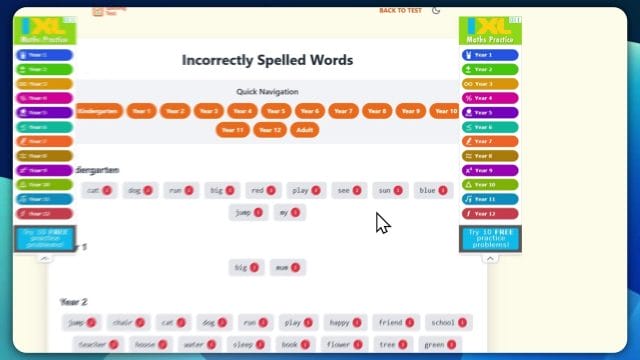
The incorrect word list appears at the end of a test and gathers any words you did not spell correctly. It also includes items that the wider community often finds difficult. This dual focus is powerful. It combines your personal needs with common trouble spots, which means your review time targets both individual and universal patterns. Many learners unknowingly spend time on words they find easy because those words feel comfortable. The incorrect word list counters that by steering you towards discomfort, which is exactly where growth lies.

As you work through the list, you will notice an immediate emphasis on clarity. You can replay the audio. You can read the definition. You can read the example sentence. There is no clutter. With that quiet setup, you are more likely to catch micro features such as a schwa in an unstressed syllable, the difference between s and c in cious endings, or the silent letter that hides in words like indict and subtle. If your spelling is technically correct but you suspect your grasp of meaning is shaky, the context lines will shore up that knowledge and help secure the spelling in your memory.
The incorrect word list also makes spaced repetition manageable. You take the list, practise it the same day, revisit it the next day, check it again after three days, and then after a week. Each pass should be short and precise. Focus on listening and writing, not on elaborate notes. By the second or third pass, you will feel the words become easier to recall and to spell. The app’s gentle layout keeps you close to the audio and text without distraction.
Pattern families and strategic grouping
One clever way to use the app is to group your review words into pattern families. This means gathering words with similar endings, prefixes, or letter clusters, then practising them back to back to create contrast in your perception. For example, take words with cious endings such as delicious, malicious, auspicious, and precocious. Listen, write, and carefully watch the c and i placement. Contrast those with tious words such as facetious, cautious, and ambitious. By placing these sequences in proximity, your ear and your eye begin to notice the subtle differences. The app makes this simple because you can select shorter custom sets and run them without a timer, then switch to a timed test once the pattern feels stable.
Another family might be words with ph for f. Consider philosophy, phantom, euphemism, and cacophony. In each case, the audio remains crisp, and the definition grounds the spelling in meaning. Over successive days, run a ten item test that mixes these with other clusters, then gradually deploy the timer to create fluency. The goal is not speed itself but secure recall under mild pressure. The app encourages that blend of accuracy and fluidity without pushing you into stress.
Applying the app in classrooms
Teachers often seek tools that respect mixed ability needs without creating a complex setup. The app fits that brief because it offers simple level selection, custom word counts, and optional timing while keeping a unified interface. A teacher can set a twenty word test at Year Seven level for most pupils, while a higher group takes a more advanced list of ten words, and a support group works with eight high frequency words. All groups can use the same classroom instructions. Everyone wears headphones or works in a quiet space. Everyone listens closely, types or writes each word, checks the definition, and reviews their own incorrect list afterwards.
In whole class mode, a teacher can play the audio through speakers for a short warm up, then ask pupils to work individually on their own devices. The sentence and definition support independent learners. Pupils who finish early can run a second test on a shorter list, while those who need more time can pause the timer or test fewer items. The classroom does not become a noisy competition because the app’s design discourages distraction. The focus remains on listening, writing, and reflection.
Teachers can also use the adult level lists for extension. That is particularly useful in secondary settings where some pupils have a strong appetite for vocabulary growth. The audio stays accessible, and the structure helps those pupils practice with precision. Meanwhile, learners who need reinforcement can stay on high frequency sets and repeat them across a week. The same app supports both ends of the spectrum through its simple controls.
If your school uses tablets or laptops, the app’s clean layout translates well across devices. The buttons are large enough for younger pupils, and the text is legible. Pupils with additional learning needs can benefit from the repeat audio and the calm pace enforced by single item prompts. Teachers can also prepare custom lists taken from a unit of study, such as science terms or geography names, and load those into a test so that spelling practice supports content learning.
Group management and routine planning
To build a sustainable classroom routine, consider a weekly cycle that balances breadth and depth. On Monday, run a new list linked to current reading. On Tuesday, revisit the incorrect word list from Monday with slow, untimed practice. On Wednesday, introduce a short mixed pattern set that includes a few new items and a few from Monday’s misses. On Thursday, turn on the timer for a light fluency session. On Friday, complete a final review and ask pupils to write three sentences using their favourite new words. This five day cycle keeps the learning moving forward while building solid memory through repetition.
Peer support can be helpful without turning the app into a social space. Pair pupils to explain patterns to each other after a test. One pupil might say, notice that delicious has cious and a soft c sound, while ambitious uses tious. By articulating the pattern, the explaining pupil deepens their own knowledge. The listening pupil gains a practical strategy for the next attempt. Teachers can give short prompts such as, identify the tricky letter cluster and say it out loud, or, locate the stressed syllable and mark it in your notebook. These prompts fit the app’s audio first approach.
Accessibility and user comfort
Accessibility begins with clarity. The audio is clean and free from reverb, and the voice is measured. The text is readable, with good contrast, and the layout avoids clutter. For users with sensitive hearing, the volume control keeps the sound gentle. For users who benefit from repetition, the replay button is present at all times. For users who prefer to read before writing, the definition and sentence can be opened first. The app does not force a single path. It provides options while maintaining a calm core experience.
Keyboard navigation is straightforward. You can tab through controls and enter text without relying on a mouse. This supports users who need alternative input methods. The app also maintains predictable focus order, which reduces cognitive load. While screen readers are not central to this audio led design, the app’s clean structure makes it more compatible with assistive technology than many competition heavy tools. If you require captions, the definitions and sentences act as semantic anchors, and teachers can provide printed handouts with a selection of items to support learners who cannot use audio.
Colour choices respect readability. There are no flashing elements or distracting animations. The interface uses plain backgrounds and simple highlights to indicate active fields. This helps users with attention challenges remain focused on the sound and the letters. It also benefits anyone working in a busy environment. Minimal design is not only aesthetic. It is functional for learning.
Custom lists and curation
While the built in levels cover a broad range of school and adult vocabulary, many users enjoy building custom lists that align with their reading and writing goals. A teacher might include terms from literature study such as soliloquy, allegory, and metonymy. A science student might load photosynthesis, anaerobic, and mitochondria. A musician might practise crescendo, staccato, and arpeggio. The app’s single item prompt and clean audio treat these lists with the same clarity as the default sets.
Good curation is a craft. When you build a list, aim for thematic coherence and mixed difficulty. A list that contains three easy items, six medium items, and one challenging item often yields better focus than a long stretch of difficult words. You can rotate the challenging slot each day so that your review remains fresh. If a list includes many words with similar endings, consider splitting them across days so that you avoid fatigue. Use the app’s optional timer sparingly at first. Once you notice steady accuracy, turn the timer on and test your fluency.
Learners who enjoy etymology can add roots and suffix cues to their notebook as they practise. For example, in benevolent, bene means good, and volent relates to wishing. In circumspect, circum means around, and spect means look. By pairing audio with root awareness, you multiply your memory signals. The app does not require this level of study, but it welcomes it by keeping the space quiet and focused.
Privacy and data
For schools and families, privacy is a concern. This app keeps its footprint modest. It records your test results to provide feedback and summary statistics, but it does not require invasive data entry. You can use it without building a complex profile. In classroom settings, teachers can guide pupils to practise and record their progress with simple local notes or school platform entries. The app’s reports display accuracy, time taken when applicable, and the incorrect word list. That is enough to guide planning without storing unnecessary information.
If your school applies strict policy, confirm the exact data storage and the jurisdiction in which it operates. The design philosophy of the app aligns with a minimal data approach. It exists to help you listen, write, and learn. It does not exist to harvest behavioural metrics beyond what is required for feedback. That is refreshing in a world of noisy educational technology. It also reduces the cognitive concern some learners feel when tools seem to watch them too closely.
Timers and performance training
Time pressure can help build fluency once accuracy is secure. The app’s timer is optional and sensitive. You can select generous limits and adjust them gradually as you grow more confident. If your goal is calm recall under mild pressure, start with a long allowance per item and cut it down slowly across weeks. The aim is to keep your breath steady and your hand relaxed while you write or type. Many learners rush and make careless errors when they first add time pressure. This app’s repeat audio and simple display encourage patience even within a timed setting.
One way to test your progress is to run paired sessions. First, complete a set without the timer and note your accuracy. Then run the same set with a gentle timer and see if your score remains stable. If it drops, return to untimed practice and focus on a handful of items, especially those with tricky clusters. Only once your untimed accuracy rises back to a strong level should you reintroduce the timer. That stepwise method is more reliable than jumping directly into tight limits and hoping to adapt.
Breath and rhythm in timed sessions
The audio has its own rhythm. You can use that rhythm to anchor your breath during timed sessions. Press play, listen fully, breathe out, and then write. If stress builds, pause between items to reset your attention. The app’s minimal layout makes this easy. There is no score ticker that tries to push you faster. Your internal rhythm and the measured voice guide the pace. Over time, this builds a calm confidence that transfers to real exams where spelling under time constraints matters.
Advanced adult level practice
The first part of our walkthrough illustrated adult level items such as obfuscate, pernicious, mellifluous, sagacious, and cacophony. Let us extend that practice with further examples that showcase the app’s method. Take paraphernalia. Listen for pa ra pher na lia, with stress near the ne lia. The ph cluster may tempt you to write f, but the pattern uses ph. The lia ending can confuse, so rely on the audio and the definition. The sentence in context will anchor the meaning as equipment or items associated with a particular activity.
Consider idiosyncrasy. Break it into i dio syn cra sy. The syn segment carries the y consonant sound, not a simple i. The crasy ending also lures common errors. Watch the placement of the y at the end. If you misplace it, the audio will flag the error, and the definition will pull you back to the sense of habitual way of behaving.
Pusillanimous is another that rewards careful listening. Pu sil la ni mous, with pu as a distinct syllable and double n not present. The ll appears only once, so the trap is miscounted doubles. The meaning of timid or lacking courage anchors the spelling, and the Latin root of little helps if you enjoy etymology. The app’s crisp prompt helps you hold the unusual letter order in mind.
Defenestration invites attention to the de fe nes tra tion segmentation. The central nes tra feels unusual. It is easy to drop the s or misplace the e. The app’s repeat function gives you time to reinforce the shape. The definition with a window also makes the word memorable, which protects the spelling.
Sesquipedalian provides a rich test of rhythm. Se squi pe da lian. The squi cluster demands care, and the lian ending can blur if you rush. The meaning of using long words aligns with this practice itself. When you write it, stay calm and follow the audio. The app never crowds the screen, so your attention remains on the sound and the letters.
Antidisestablishmentarianism is a marathon word. It is best approached as anti dis establish ment arian ism. The audio will steady your pace while the definition keeps the political and historical context in view. The danger here is fatigue. Do not attempt this word early in a timed set. Place it in an untimed practice where your focus is gentle and the repeat button is your friend. The example sentence, when present, crystallises the sense and makes the long construction less daunting.
Stress, schwa, and consonant blends
In advanced practice, three features recur across many words. Stress placement, the schwa sound, and consonant blends. Stress determines which vowel feels vivid and which falls towards a neutral sound. The schwa is the neutral vowel in an unstressed syllable, which often causes letters to feel vague. Consonant blends such as str, spl, and phr pack several sounds together and can confuse the hand when typing or writing fast. The app’s audio highlights these features by keeping the voice steady and the sound clean. The definition and sentence allow you to slow down and confront the pattern rather than guessing.
To train your ear and hand on blends, create micro drills. For one week, include three words with str every day, such as structure, stringent, and stratagem. On the same days, include three words with ph, such as epiphany, metaphysical, and telephony. These small, regular drills sharpen your perception and make the clusters feel familiar. By pairing them with meaning, you prevent rote memory from fading. The app’s structure supports this blend of listening and thinking.
Mixed ability practice in families and small groups
Families often seek shared activities that support different ages without generating friction. The app makes that possible. A parent can run a five word test for a younger child at Year Two level while an older sibling runs a ten word test at Year Eight level. The parent can then compare both end of test summaries and sit with each child for five minutes to talk through the incorrect word list. Because the interface is quiet and stable, this review chat feels calm. The parent can encourage attention to syllables and patterns without managing a elaborate app flow.
In small group tutoring, the app offers a session structure that fits a half hour slot. Begin with a short shared audio prompt for three words that the tutor selects. Ask each learner to write the words on paper. Then have each learner run a five word test at their level while the tutor circulates and supports any confusion. Finish with a group reflection where each learner shares one pattern they noticed. The tutor keeps a list of those patterns and builds the next session around them. This method lines up perfectly with the app’s focus on listening, writing, and deliberate review.
Integration with reading and writing tasks
Spelling practice is most powerful when it supports reading and writing tasks. The app enables that integration by tying each word to a definition and a sentence. Teachers and learners can extend this by writing their own sentences after a test, using the newly mastered words in context. If a lesson includes a paragraph of descriptive writing, pull three words from that paragraph and add them to a test. Practise them with the app, then return to the paragraph and revise it, now with more accurate spelling and stronger vocabulary.
In reading groups, encourage members to note unfamiliar words and collect them into a list for the app. Run the list at the start of the next session. Discuss meanings after the test. This keeps the reading experience rich and the spelling practice directly connected to comprehension. The audio prompt places the sound shape in memory, while the discussion cements the semantics.
Case studies from real testing
Secondary pupil building confidence
A Year Nine pupil struggled with high frequency errors in words like necessary, definitely, and separate. The pupil used the app three times a week for four weeks. In week one, they practised ten words without a timer, focusing on audio replay and syllable marking in a notebook. In week two, they repeated the same list with two new additions and enabled a generous timer. In week three, they switched to adult level items for challenge and added five custom words from their history notes. In week four, they removed the timer and focused entirely on the incorrect word list each day. Their final summary showed accuracy rising from sixty two percent to ninety percent, with necessary and separate now solid. The pupil reported feeling calmer when writing under time in an English assessment.
Adult learner expanding vocabulary
An adult learner in a professional setting wanted to expand their vocabulary and improve spelling accuracy in reports. They built custom lists of ten words with clear definitions relevant to their field, such as fiduciary, contingency, remediation, and arbitration. They used the app four mornings a week, always with headphones and five minutes of quiet space. They allowed themselves to replay the audio twice per word, and they wrote the word by hand in a notebook after typing it in the app. Over eight weeks, they reported fewer spelling corrections in documents and a sharper sense of word form. The simplicity of the interface helped them stay consistent.
Primary class consolidating core patterns
A Year Three class struggled with double consonants after short vowels in words like rabbit, kitten, and banner. The teacher built a set of twelve words that illustrated this pattern clearly. The class ran a weekly cycle as described earlier. By week three, the class average accuracy climbed notably, and several pupils who initially resisted audio practice began to enjoy the calm routine. The teacher noted that the definition prompts helped pupils use the words in sentences during writing time, which reinforced the spelling in a natural way.
Strengths and limits
Every tool has strengths and limits. The app’s strengths are clarity, focus, and alignment with British and Australian usage. The audio is clean. The interface is calm. The definitions and sentences anchor meaning. The level selection offers breadth, from early school years to adult vocabulary. The incorrect word list and spaced review dynamic support lasting progress. The timer option enables fluency training without pressure. The app fits classrooms, families, and solo learners.
Its limits are largely a consequence of its commitment to minimal design. If you want a social community, live competitions, or elaborate rewards, this is not that tool. If you want flashy visuals, this will feel restrained. The app also assumes you will take responsibility for your process. It gives you a clear environment and accurate prompts, but you must show up consistently and use the incorrect word list with discipline. For most serious learners, that is an advantage. The tool invites you to do the real work where progress happens.
Setup guide for confident beginnings
Before your first serious session, prepare the following.
- Choose headphones or a quiet space where you can hear the audio without interruption.
- Select an appropriate level. If unsure, begin one level below your current comfort to secure early success.
- Pick a manageable word count. Ten is a good start for adults. Six to eight suits younger pupils.
- Turn off the timer for your first session to focus on accuracy and listening.
- Open a notebook for pattern notes and syllable marks if you enjoy writing by hand.
During the session, follow a simple rhythm.
- Press play and listen fully. If needed, replay once without typing.
- Type or write the word. Say the syllables softly to yourself.
- Read the definition and sentence to anchor meaning.
- Move to the next word calmly.
After the session, plan your review.
- Study the incorrect word list and replay the audio for each item.
- Write the difficult items in your notebook with syllable marks.
- Schedule a short review the next day and another after three days.
- Consider adding the timer in week two if your accuracy stays strong.
Frequently asked questions
Can British learners use the audio comfortably
Yes. The accent is Australian, which sits comfortably for British ears. The voice is clear and measured, and the audio is recorded to professional quality. British conventions such as organise, colour, centre, jewellery, and catalogue appear in the lists. The definitions and example sentences reflect standard usage, so you do not encounter confusing regional idioms. The audio plus context approach ensures transfer across British and Australian classrooms.
Should I always use the timer
No. The timer is a tool for later stages, once your accuracy is secure. Begin without a timer to develop precise listening and correct spelling. When you feel confident, add a gentle timer to train fluency under mild pressure. If your accuracy drops, remove the timer and rebuild. The app’s design encourages patience and consistency.
How many words per session are ideal
There is no single ideal number. Ten to twelve suits many adult learners. Six to ten suits younger learners. The key is to protect focus and quality. It is better to master eight words with insight than to rush through twenty with shallow attention. The incorrect word list will guide you towards the items that deserve extra time.
Can I customise lists for subject study
Yes. You can build lists that target subject terms and practise them within the same clean interface. Use definitions that match your course material and craft sentences that reflect your readings. This aligns spelling with content learning and yields strong retention.
What if I struggle with one cluster repeatedly
Create micro drills that isolate the cluster. Practise three to five words with that cluster daily for a week, using the app’s repeat audio and calm display. Write the words by hand after each attempt. Read the definitions. Then mix the cluster into longer tests to integrate the skill. Be patient. Clusters yield with consistent practice.
Troubleshooting and small refinements
The audio sounds too fast
Use the replay button and listen twice before typing. Slow down your breathing and mark syllables quietly. Practise without the timer for several sessions to settle your rhythm. The voice is measured, and your ear will adapt with repetition.
I keep misplacing silent letters
Focus on the definition and the sentence. The meaning often points to the letter history. Write the word in your notebook and circle the silent letter. Repeat the test the next day. The app’s immediate feedback will reinforce the placement.
My accuracy collapses under time pressure
Remove the timer and rebuild accuracy with short sets. Once stable, add a generous timer and cut it down over weeks. Pair timed and untimed sessions to compare scores. The aim is calm fluency. The app supports that balance.
I confuse similar endings
Group your practice into families such as cious and tious, or ent and ant. Build small drills and run them daily for a week. The audio and definitions will sharpen your perception. Then return to mixed lists to ensure transfer.
Etymology and memory aids
Many learners find that roots and suffixes create sturdy memory hooks. The app does not overwhelm you with etymological notes, but you can bring that knowledge into your practice. For example, in confluence, con means together, and flu relates to flow. In terrestrial, terr means earth. In chronology, chrono means time, and logy means study. By pairing these cues with audio and context, you create layered memory. The more signals you attach to a word, the more likely you are to spell it correctly without hesitation.
Imagery is another aid. When you hear cacophony, imagine a busy street with clashing sounds. When you hear mellifluous, imagine a smooth, honeyed melody. The app’s sentence often evokes such images. Let the image align with the spelling. If a cluster proves stubborn, draw it creatively in your notebook and place it near the image. This cross modal approach suits visual learners and deepens retention.
Long term progression plan
Progress unfolds in stages. Begin with high frequency words and core patterns. Expand to mid level vocabulary that appears in reading and school assessments. Introduce adult level items for challenge and breadth. Along the way, cycle between untimed precision and timed fluency. Maintain your notebook with pattern notes and occasional etymology cues. Use the incorrect word list as your steering wheel. It tells you where to direct your attention. Keep tests short enough to remain fresh but long enough to build stamina.
Every few weeks, run a diagnostic session where you attempt a variety of words without a timer and note the clusters that fail. Build a targeted plan for the next fortnight around those clusters. Repeat the diagnostic later and compare. The app’s calm space and reliable audio make such cycles feel steady rather than stressful. Over months, you will notice that words that once felt difficult now feel secure, and your writing displays fewer errors.
Curriculum alignment and British usage
For learners in the UK, alignment with British spelling is essential. The app honours that alignment through consistent lists and audio prompts that match standard British usage. It adopts spellings such as organise, colour, centre, jewellery, catalogue, aluminium, and manoeuvre. If you teach in a British context, you can trust the lists to reflect classroom expectations. Where variation exists across Commonwealth usage, the app chooses forms that sit comfortably with British conventions.
Teachers can map lists to curriculum outcomes by selecting words from reading materials, exam practice papers, and subject glossaries. The app’s simplicity allows everyone to focus on the core tasks that support those outcomes. Pupils are not drawn away by superficial entertainment. They practise listening and spelling and then apply that skill in reading and writing tasks. The result is a more coherent path from practice to performance.
Using the app alongside dictionaries and style guides
Spelling confidence interacts with dictionary use and style choices. When you practise with the app, you acquire a mental library of forms that reduces dependence on constant checking. At the same time, it is wise to cross check unfamiliar words in a reputable British dictionary when writing formal documents. The app’s definitions are clear and practical, but a full dictionary entry can add nuance. A style guide for your institution may also specify preferences on items such as programme versus program in certain contexts. The app builds core skill and awareness. Strategic reference tools refine your final choices in professional writing.
Encouraging persistence and a growth mindset
Perhaps the most valuable feature of the app is the way it supports a growth mindset. It shows you your mistakes without judgement. It offers immediate tools to correct them. It allows you to move at your own pace while encouraging consistent practice. As you watch your accuracy climb, you feel the satisfaction of earned progress. That feeling is not the thrill of a game score. It is the deeper confidence that comes from mastering a useful skill.
To sustain persistence, keep sessions short and regular. Link practice to meaningful tasks such as writing an essay or preparing a presentation. Celebrate small wins by noting specific patterns that you have conquered. Share progress with a teacher, a friend, or a family member. The app’s gentle design makes it easier to return day after day without fatigue. In time, the habit merges with your reading and writing life, and spelling accuracy becomes a natural companion to comprehension and expression.
Final thoughts and verdict
The Spelling Test App is a rare example of educational software that respects the learner’s attention. It focuses on audio clarity, semantic context, and controlled practice. It aligns with British and Australian usage and fits smoothly in classrooms, homes, and adult study routines. It supports precision through immediate feedback and reinforces growth through deliberate review. It offers a timer for fluency training without compromising calm. It does not chase trends. It keeps the core task front and centre.
If you value quiet mastery, this app deserves a place in your toolkit. Put on your headphones, open a short list, and listen closely. Write each word with care. Read the definition and the sentence. Review your mistakes with patience. Return the next day and the next. The skill will grow. Your vocabulary will broaden. Your writing will show fewer errors. The path is simple, and the app walks it with you in a measured, reliable way.
For teachers and families, the message is the same. Build routines that fit your learners. Use the app to provide accurate prompts and structured feedback. Pair practice with reading and writing. Celebrate steady progress. The combination of audio, context, and repetition gives you a dependable framework for improvement. In a world of noisy tools, this one keeps learning calm and effective.
That is the essence of the review and the testing experience. Clear sound. Clear words. Clear practice. In sum, the Spelling Test App is an excellent choice for anyone serious about spelling, vocabulary, and attentive listening in British and Commonwealth contexts.

If this article helped you in any way and you want to show your appreciation, I am more than happy to receive donations through PayPal. This will help me maintain and improve this website so I can help more people out there. Thank you for your help.
HELP OTHERS AND SHARE THIS ARTICLE
LEAVE A COMMENT

I am an entrepreneur based in Sydney Australia. I was born in Vietnam, grew up in Italy and currently residing in Australia. I started my first business venture Advertise Me from a random idea and have never looked back since. My passion is in the digital space, affiliate marketing, fitness and I launched several digital products. You will find these on the portfolio page.
I’ve decided to change from a Vegetarian to a Vegan diet and started a website called Veggie Meals.
I started this blog so I could leave a digital footprint of my random thoughts, ideas and life in general.
If any of the articles helped you in any way, please donate. Thank you for your help.
Affiliate Compensated: there are some articles with links to products or services that I may receive a commission.