In every living body, the front goes first. The front is the point of first contact, the place where the unknown meets intention. It is the part that senses pressure before the rest, that feels the texture of the path, that chooses a direction, and that carries the organism forward. Leadership begins here. Not as a title, not as a platform, but as a willingness to occupy the space ahead of the group and to move before certainty is available. This is not a grand stance. It is a grounded one. It is less about height and more about placement. The front is not above the body. The front is ahead of it.

When the front moves, the rest has permission to follow. When the front pauses to sense and to decide, the rest waits in readiness. When the front is clear, coordinated and courageous, the body becomes a coherent force. This is not theory. It is biology. It is also the quiet truth behind every team that makes real progress in uncertain situations. The front does not see the whole journey. It rarely can. What it does is even more valuable. It chooses a direction and begins to move with purpose.
The Anatomy of the Front
Consider how a body moves through a dark room. The front feels the air first. The hand that reaches out makes contact with the unseen, the shoulders align, the eyes scan for slivers of light. The rest of the body does not challenge the front for supremacy, because the front is simply the part that is closest to reality. This is the essence of leadership. Leaders position themselves where reality is felt most sharply and choose to act from there.
There are three features to the front that matter for leadership.
- Sensory primacy. The front receives the first signals. Leaders seek information early, ask the question most are hesitant to ask, and track faint signs. They do not wait for perfect data. They cultivate early signals and make them legible to others.
- Directional choice. The front initiates orientation. Leaders draw a line between here and there. They do not claim to know everything. They make a choice so that energy can organise.
- Transfer of movement. The front translates intention into motion. Leaders turn words into steps and then into momentum. They create movement that the group can join, not just ideas that the group can discuss.
These three features mean that leadership is not about authority alone. It is about proximity to the edge, the courage to choose, and the skill to move first in a way that others can match. Authority helps when it clears obstacles. It hinders when it seeks to dominate the edge from a comfortable distance.
Leading Without Seeing the Whole Journey
The front does not see the end. It rarely sees beyond the next few steps. Yet it moves with integrity. How does a leader make sound choices without the map fully drawn. The answer lies in direction, not detailed prediction. Direction creates coherence under uncertainty. It does so by anchoring on purpose, principles and present information. Decisions then become a series of small, honest commitments rather than once only bets.
To make directional decisions when you cannot see the entire path, practise the following disciplines.
- State a clear intent. Articulate the outcome you want to bring about in plain language. For example, we will improve customer response time by half within this quarter. Intent is a north star that reduces thrashing and dramatised debate.
- Name the boundaries. Identify constraints that cannot be violated, such as safety, ethics, regulatory requirements, or a crucial budget limit. Boundaries make directional freedom safer and faster.
- Choose a nearest right step. Ask what small, real step moves us towards intent with the least regret if we must reverse. Choose that step, then move. Treat the step as a probe, not a promise of the whole path.
- Design fast feedback. Before you move, define what you will watch to learn quickly. Decide which signal will tell you to accelerate, hold or adjust. Speed of learning is more valuable than elegance of the initial plan.
- Share the direction aloud. Make your direction legible. Speak it, sketch it, write it where others can see. Then invite questions that refine it without paralysing motion.
When a leader takes these actions, the team does not need omniscience. They need orientation. The group can now align micro decisions with a shared direction because the front has said, here is where we are going next, and here is how we will know if it is working.
Searching in Darkness
When darkness comes, the front does not stop. It searches. This is a precise behaviour, not a vague metaphor. Searching means active sensing, deliberate movement and continual adjustment. It is the opposite of aimless drift and the antidote to panicked rush. Searching in leadership looks like a series of focused experiments guided by purpose.
There are three states that often get confused when conditions are dark.
- Stillness. A calm pause to improve perception. Stillness is intentional and brief. Leaders use stillness to hear more and to reduce noise.
- Stagnation. A fearful hold, hidden behind busy work. Stagnation drains energy and erodes trust. Teams sense it immediately.
- Search. Purposeful movement with a high rate of learning. Search uses small probes, honest reflection and quick iteration.
To adopt a search posture under pressure, use a simple rhythm.
- Frame a question. For example, which two actions will most improve retention for our most at risk customers this month.
- Design two small tests that answer the question. Make them safe to adjust, inexpensive, and fast to run.
- Move. Launch the tests on a short cycle. Resist the urge to over perfect or to scale too soon.
- Sense. Look for leading indicators rather than waiting for lagging metrics. Gather stories and numbers.
- Decide. Keep what worked, adjust what did not, and discard what misled. Then take the next small test or scale the win.
The power of search is that it preserves momentum while truth emerges. It replaces the fantasy of perfect foresight with a practice of disciplined discovery. The team learns to associate uncertainty with action rather than with fear.

Finding the Other Side of the Light
Searching is not indefinite. The aim is to find the other side of the light, the next patch of clarity where the group can accelerate. Leaders turn tiny findings into shared wins that enlarge confidence. They do this by naming the learning, sharing the proof, and moving the boundary of the known a little further forward.
Practice this simple sequence.
- Name the insight. State plainly what you learned. For example, customers responded to live callbacks within ten minutes at four times the rate of any email.
- Show the evidence. Share a short data point, a customer quote, or a quick demonstration. Let the team see and feel the truth.
- Upgrade the standard. Turn the insight into a new team habit. For example, we now commit to live callbacks within ten minutes for all priority tickets.
- Accelerate. Move resources to amplify the new standard. Make it easier to do the new right thing than the old easy thing.
Each time the front finds a bit of light and pulls the standard forward, the body becomes more capable. Confidence then is not a hollow pep talk. It is the memory of many small proofs.
Why the Body Follows the Front
Teams do not follow because the path looks easy. They follow because they trust the leader. Trust is the bridge between individual fear and collective movement. It is earned through three intertwined signals that a leader sends again and again.
- Care. People need to know they are not just a means to an end. Leaders show care by learning names, noticing effort, making time, and protecting the essentials that keep people whole. Care builds safety.
- Competence. Care without competence breeds frustration. Leaders must deliver real outcomes. They must make sound decisions, keep promises, and lift the performance bar by example. Competence builds respect.
- Consistency. Competence without consistency breeds doubt. Leaders must be dependable in tone, principles and presence, especially when stakes rise. Consistency builds predictability.
Trust grows when care, competence and consistency are present together. It is fragile when any one is absent. A leader who articulates empathy but avoids hard calls is loved but not followed. A leader who is skilled but erratic is feared but not followed. A leader who is steady but distant is tolerated but not followed. Followership is a rational choice in the presence of the right signals.
There are practical ways to grow trust in daily work.
- Open the decision logic. When you decide, share how you weighed trade offs. People can accept a choice they disagree with if they understand the reasoning and feel seen within it.
- Match words to calendars. Align your diary with your stated priorities. If you say customer obsession but spend no time with customers, trust declines. Time is the truest signal of priority.
- Own the first mistake. Say, I missed that. Here is what I will change. Owning the first mistake gives the team permission to tell the truth and correct course quickly.
- Make your promises small and keep them. Many tiny kept promises become a bank that the team draws on during hard stretches.
Standing Ahead, Not Above
Leadership is not about status. It is about place and posture. Standing ahead means you take the first step, absorb the first shock, and share the first sighting of hope. Standing above shifts attention to comparison and control. It dulls senses and creates distance from reality. The paradox is that a leader who insists on being above is often the last to know. A leader who insists on being ahead is often the first to serve.
To practise standing ahead rather than above:
- Draw closer to the edge. Spend time where customers are, where the product is used, where errors happen, where friction is felt. Listen without banner or entourage. Ask naive questions. Edge time keeps you honest.
- Use authority to clear the path, not to display power. Authority removes blockers, resolves conflict and allocates resource. It is a tool for service, not a badge.
- Be visible at the first mile. Show up early in new efforts. Do the unglamorous work that creates momentum, whether that is writing the first draft, demoing a rough version, or calling the difficult stakeholder.
- Create peer space. Invite your team to step ahead of you in their domain. Give them the front in their lane. This is how a group grows many points of contact with reality.
Standing ahead shifts the culture. People stop performing for the leader and start contributing to the mission. This releases energy that control can never buy.
The Front Feels the Pressure First
The front meets the wind before the rest. It receives the head on force of uncertainty, criticism and time pressure. Leaders often mistake this pressure as a signal that something is wrong. In truth, it is a sign they are in the right place. The task is not to avoid pressure but to metabolise it in a way that keeps the body moving.
Pressure has three sources in leadership work.
- Decision density. Many choices arrive at once, often with incomplete information and conflicting constraints.
- Emotional contagion. The mood of the group flows toward the front. Anxiety seeks a sink. Hope seeks a source.
- Visibility load. Actions at the front are seen and often judged before outcomes unfold. Interpretation comes fast and loud.
These loads are real. They can be carried with grace through disciplined personal practices that maintain clarity and capacity.
- Protect a daily clarity window. Reserve a short block each morning before meetings to write, think and set intent. Use this to define your three must do actions. Guard it. This window pays for itself many times over across the day.
- Use state resets. Learn two or three quick state resets such as a long exhale, a short walk or a brief name and notice practice. Resetting your state under pressure makes better choices possible.
- Run decision triage. Not all decisions deserve the same depth. Label decisions as reversible or expensive, and deal with reversible ones quickly with enough quality, reserving deep cycles for the few that truly matter.
- Build a personal counsel. Two or three trusted peers outside your line can absorb vents, challenge blind spots and prevent isolation. Use them as a sounding board when noise is high.
Facing Obstacles First
The leader meets obstacles first. Obstacles are not only external blockers. They are also internal hesitations and cultural habits. A leader clears both. External obstacles often yield to a blend of creativity and influence. Internal obstacles yield to example and repeat signals.
To remove obstacles with leverage:
- Name the hidden constraint. Often a process, policy, or unwritten rule is the true block. Ask your team, what rule are we following that no longer serves the mission.
- Absorb the first escalation. Take the hard conversation so the team can keep moving. Do not pass the heat down. Convert it into clarity and then distribute that clarity.
- Swap friction for flow. Simplify one step that everyone feels. For instance, remove one approval layer or turn a long template into a short checklist. Small changes at common choke points release outsized energy.
- Shine a light on heroics. If people are winning despite the system, honour the effort and then fix the system so that the win becomes normal rather than heroic.
As you remove obstacles, do not forget the internal ones. Habit lives in the body of the team. Fear of looking foolish, fear of being blamed, belief that nothing changes, these are obstacles too. Leaders disarm them by going first in visible ways. Ask a naive question in a big meeting. Share an early draft with clear requests for critique. Admit when you do not know and then start the search. These acts lower the waterline for everyone.
Taking the Risk First
Risk at the front is not bravado. It is responsibility. You go first to reduce the cost of motion for others. Your willingness to be wrong, to learn in public, to absorb the first wave of doubt, converts a dangerous unknown into a navigable space. The team does not need you to be fearless in the sense of feeling nothing. They need you to be courageous in the sense of moving with fear present and values intact.
Practical ways to take the risk first without gambling the mission:
- Run safe to learn trials. Create small arenas where new approaches can be tried without threatening the core. Protect the people who run them. Share the learning widely.
- Stake your reputation on the first draft. Publish your first version of a plan or concept and invite improvements. Signal that progress beats polish.
- Absorb blame, share credit. When something fails, say this was my call; here is what I learned. When something succeeds, name the contributors specifically. This trains the group to act from mission, not personal protection.
- Be precise about irreversible risks. Separate risk that affects life, law, safety or mission integrity from the reversible sort. Be very conservative with the first, very curious with the second.
In Business, It Is No Different
It is tempting to see the poetry of leadership as separate from the mechanics of business. In truth they are one. A company is a living body. Marketing senses the market. Product reaches for the future. Operations stabilises the gait. Finance sets metabolism. People functions supply nutrients. The front is not a department. It is wherever the next honest decision must be made.
Your team moves when you move. This is a law of motion inside organisations. If you move with clarity and tempo, the group takes on that rhythm. If you stall in analysis, the group will become expert in elegant delay. If you push without listening, the group will adopt surface compliance and private resistance. Your movement writes the cultural script.
The team believes when you believe. Belief here is not denial of facts. It is confidence grounded in evidence and in the memory of past wins. When you hold that posture, others can borrow it. When you leak doubt without offering a path, others feel unmoored. Belief is a choice to interpret challenges as solvable and to act as if our actions matter. That choice becomes contagious.
The team holds strong when you hold strong. Strength is steadiness under load. It shows up in tone, in pace, in refusal to lash out. When you hold strong you do not pretend it is easy. You say it is hard and we can handle it. That sentence alone has saved many teams from spiralling.
Practical Rhythms That Teleport Movement, Belief and Strength
Culture is a set of repeated behaviours under pressure. Put these rhythms in place and the group will begin to move as one.
- Set a weekly direction update. A short note or stand up where you restate intent, share what changed, and clarify the next step. Consistent direction reduces gossip and drift.
- Create a win ledger. Capture tiny wins each week. Share them in team time. Make them specific and linked to the mission. This builds earned belief.
- Adopt a no drama rule in crisis. Speak plainly, assign tasks, and avoid blame language. After the crisis, run a blameless review to learn. This builds strength under load.
- Portfolio the work. Visualise current bets across time horizons, risk levels and resource use. Make sure you have quick wins, medium builds and longer bets. Movement then has layers of momentum.
In Difficult Times, Direction Beats Perfection
Perfection is a mirage that paralyses teams when stakes rise. Direction is an anchor that frees them. People do not need all the answers. They need a path that makes sense and a leader willing to take the first step. Direction is a clear vector. It is not a script. It leaves space for adaptation and contribution. It focuses attention and lets people do their best thinking within shared boundaries.
What does good direction look like in practice.
- It is short. One to three sentences are enough to orient a team for the next cycle. If direction needs a deck, it is probably a plan, not a direction.
- It is concrete. Use verbs and nouns people can see. Increase first response speed to customers by half is better than improve customer focus.
- It is bounded. State time frame and constraints. For the next two weeks within current budget we will test three ways to reduce onboarding time.
- It is revisable. Direction is not a decree set in stone. It is open to learning. Say, we will adjust on Friday based on what we learn.
Perfection is seductive because it promises safety. It lies. It gives the illusion of control while time slips away. Direction invites risk but offers speed and learning in return. It replaces fear of error with a design for iteration. Under real pressure, a team with strong direction will outperform a team with a perfect plan that is always nearly ready.
How to Give Direction That People Can Use
Direction is a craft. It sits at the intersection of clarity and courage. Use this method to give direction in a way that unlocks action.
- Start with context. In one minute, share the why behind the direction. People execute better when they understand the stakes.
- Name the vector. Say what we are doing next as a single sentence. Use simple language.
- Define success signals. Explain how we will know if the move is working within a short time window.
- Set the boundaries. Name what is in scope and what is not, what can be changed and what is fixed.
- Invite agency. Ask, what do you need to move now. Then listen and remove blockers.
- Time box. Give a clear horizon for review. People commit more fully when they know a chance to adapt is coming.
After you give direction, watch for friction. If your team stalls, it is often because something in your direction remains vague. Clarify the vector, reduce the scope, or shorten the time frame. Keep adjusting until movement feels natural, not forced. Then protect the direction from unnecessary changes until the review point arrives.
Going First When You Do Not Have All the Answers
People do not need full certainty to begin. They need evidence that you will go first. This means you will make the first call, take the first meeting, write the first email, ship the first version, stand up in the first awkward conversation. Going first lowers the activation energy for everyone else. It removes the social risk that often outweighs the practical one.
You can go first in many small ways.
- Publish an early view. Share your draft thinking before it feels safe. Ask for direct critique. This normalises learning in public.
- Call the hard truth. If a project is off track, say it out loud, calmly and early. Clarity is kindness. Once spoken, the group can move to solutions.
- Start the customer loop. Make the first call or visit. Bring the story back. Nothing beats direct contact with reality.
- Move a small stone. Fix a tiny irritant that everyone complains about. The signal is, we can change things. Momentum often follows from the smallest proof.
Going first is not about heroics. It is about modelling. The aim is not to be the only one who moves. The aim is to make movement a shared pattern so that soon many people are going first in their own sphere. That is how a team becomes self propelling.
Purpose as a Compass for Many
When one leads with purpose, many find their way. Purpose turns individual movement into collective alignment. It tells people why their effort matters beyond themselves. It gives meaning to the sacrifice that real progress demands. Purpose is not slogans on walls. It is the true reason your work deserves your best. People feel purpose when decisions consistently point in the same direction for reasons that match their values.
To use purpose as a compass:
- Articulate a cause that is bigger than profit. Profit is essential. It is also a by product. Name the human value your work increases, such as trust, access, safety, joy, learning or time.
- Connect the cause to concrete choices. Show how purpose changes what you do on a Tuesday. For example, our purpose to increase access means we will simplify pricing even if it reduces near term margin.
- Invite personal alignment. Give people space to connect their own story to the purpose. Purpose grows stronger when it resonates with personal meaning.
- Measure what matters. Create a small set of indicators that show progress on purpose, not just on profit. Share them often and celebrate improvement.
Purpose does not eliminate hard trade offs. It illuminates them. It helps you choose which pain to accept. When purpose guides the front, the body bears hardship with more grace because it knows why the struggle is worthy.
From Fearlessness at the Front to Unstoppable Together
When the front is fearless, the rest of the body becomes unstoppable. Fearless here does not mean numb. It means free from the tyranny of fear. The leader feels fear, names it, and still chooses action aligned with values. This transforms fear into information rather than a master. When the front demonstrates this posture, others start to do the same. Collective courage is the result. It is a flywheel. One brave act from the leader unlocks ten brave acts from the team, which in turn generates results that reinforce the courage to keep going.
How to cultivate fearlessness that scales to the group:
- Normalise fear as data. In meetings, invite people to name what scares them about a plan. Treat fear as a signal to design better, not as a reason to halt.
- Practice graded exposure. Tackle slightly bigger challenges each cycle. Success at one level builds capacity for the next. Avoid both overwhelm and stagnation.
- Teach recovery. Courage without recovery burns people out. Build in rest, reflection and rituals that restore. Unstoppable does not mean unending. It means resilient.
- Share stories of courage. Tell real stories from within the team where someone chose the mission over comfort. Make these stories part of the culture.
As fear recedes from the centre of decisions, energy becomes available for creativity and craft. The team stops protecting itself and starts building the future. That is what unstoppable looks like from the inside. It is not invincibility. It is a calm insistence on progress.
Leading With the Body, Not Just With Words
The central metaphor endures because it is literal. You lead with your body as much as with your words. Your presence is a message. The way you enter a room, the way you listen, the way you hold silence, the way you respond to a surprise, all of this tells people whether it is safe to move. The front is a posture, not a speech.
Practice embodied leadership in simple ways.
- Adopt a listening stance. When someone speaks, orient your body toward them, soften your jaw, breathe slowly and do not interrupt. People can feel when they are heard. Listening reduces fear and releases ideas.
- Use clear gestures. Point to the board where the direction is written. Hold up a finger to mark a principle. Stand beside a whiteboard to show that you are building with the team, not observing from afar.
- Move toward friction. When a discussion heats up, step closer, slow your pace, and ask a simple question that restates the intent. Your calm movement brings the group back to purpose.
- End with a step. Always end meetings with a stated next step, a name and a time. Then take your own step first. The body of the team will follow.
Language That Moves People
Words are tools. Used well, they create movement. Used poorly, they create fog. Leaders who move first use simple language that names reality, states direction and invites agency. They avoid jargon that hides confusion. They do not over promise. They do not underplay risk. They trust people with the truth and they give them a way to act on it.
Here are phrases that move work forward.
- Here is what I know, here is what I do not know, here is what we will do next.
- This will be hard, and we can handle it.
- For the next two weeks, we will focus on this outcome. Everything else waits.
- I will go first. I will send the first note. I will make the first call.
- We will review on Friday. Bring what you learned, not just what you did.
- What do you need from me to move now.
Notice how these phrases combine honesty, direction and agency. They transmit steadiness. They hold people to a higher standard while supplying the conditions to meet it. This is the chemistry of trust in language.
Setting the Pace
The front sets pace. Too slow, and the body trips over itself. Too fast, and the body loses integrity. Pace is not speed for its own sake. It is the alignment of speed with capability and context. Leaders set a sustainable pace by alternating cycles of push and consolidate, by matching challenge to capacity, and by making rest a part of performance rather than a reward for it.
To tune pace:
- Measure energy, not just output. Ask the team weekly where their energy sits on a simple scale. Use this signal to adjust workload before cracks widen.
- Use sprints and plateaus. Run focused bursts on priority work followed by plateaus where you stabilise, fix debt and improve systems.
- Celebrate completion. Mark the end of cycles with small rituals. A line in the sand helps people reset and prepare for the next push.
- Guard slack. Maintain some slack capacity to absorb surprises. A system with zero slack breaks under pressure.
When pace is right, people feel stretched but not strained, challenged but not crushed. They sleep well, they speak up, and they keep improving. The front senses when to nudge and when to rest. It listens to the body and adjusts.
Building a Team of Fronts
Healthy organisations do not rely on a single point at the front. They cultivate many people who can step ahead in their domain. This distributes sensing, spreads risk, and accelerates learning. It also makes the culture more resilient when the original leader is away or when several fronts must be held at once.
To build a team that can lead from multiple edges:
- Define domains clearly. Give people ownership of customer segments, product components, or processes. With clear domains, leadership becomes local and responsive.
- Train for first contact. Teach people how to frame intent, run small tests, and give direction. Make this training part of onboarding and promotion.
- Rotate the visible front. In reviews and demos, let different domain leads present and decide. Back them in public. Support them in private.
- Reward learning leadership. Recognise those who go first to learn, not just those who deliver perfect results. This encourages healthy risk taking.
As multiple fronts emerge, coordination becomes the new challenge. The answer is shared intent and light touch integration. You do not need heavy control when everyone is orienting to the same north. You need simple protocols for handoffs, for signals, and for conflict resolution. The body then moves as a whole even while many parts lead locally.
When the Path Is Hard
There will be stretches where the path is genuinely hard. Markets shift, systems fail, people leave, costs rise, or accidents happen. In those moments, people do not expect perfection. They expect direction and presence. They want to see you where the pain is, not where the cameras are. They want to hear your real voice, not a script. They want to move together, not be left alone.
In hard stretches, practise three anchors.
- Show up at the scene. Go where the issue is felt. Listen first. Do small acts that help immediately. Presence reduces panic.
- Speak the three sentences. Here is what happened. Here is what we are doing now. Here is when we will update you next. These sentences quell rumours and restore agency.
- Hold the line on values. When pressure peaks, values either crumble or crystallise. Choose actions that protect dignity and integrity. People will remember how you behaved more than any outcome you achieved.
Hard paths reveal the character of leadership. They also forge it. Each test becomes material for future steadiness if you choose to learn rather than to hide.
Truth as the operating system of leadership
Truth is not a slogan. It is the operating system. When the front attends to truth, motion is honest, effort is intelligently placed, and trust accumulates as a real asset. Truth keeps direction grounded in what is, not only in what is wished for. Leadership that honours truth does not chase perfection. It chases clarity that is sufficient to move today, and it returns tomorrow to improve the clarity.
Truth is a set of practices rather than an abstract virtue. It lives in how we choose, how we share, how we correct, and how we restore after error. Every team can make truth more visible and more usable. When truth is usable, it becomes predictive in the only way that matters for humans at work. It tells us what is likely to happen if we act this way in this context, and what we can do next if reality does not respond as hoped.
Reality before reputation
The front earns trust by placing reality ahead of reputation. Reputation follows naturally when reality is named early and acted upon. Reputation collapses when truth is traded for a quick feeling of safety. A leader who is ahead invites the discomfort of unvarnished information and demonstrates that it is safe to bring it. This is not comfort for comfort’s sake. It is confidence that the team can face what is true together and choose the nearest right step.
- Invite the unfiltered report: ask someone at the scene to describe what they saw in plain language and thank them for the courage.
- Use a small truth first: begin a difficult conversation with one concrete observation that everyone can recognise as true. Build from there.
- Protect truth tellers: make it socially safe to name inconvenient facts by defending the person, not the opinion. We want the facts and the person to be safe.
- Separate identity from outcome: we can be good people who created a poor outcome. We are responsible and we can repair.
The leaderboard of honesty
In every group there is a silent leaderboard of honesty. The names on it are not always the loudest voices. They are the people who consistently bring clear data, describe context without drama, and accept correction. The front can expand this leaderboard by noticing and rewarding these behaviours. The message is that honesty is performance. It is not a side note or a risk to career. It is core contribution.
- Publicly credit a teammate who brought a hard truth early and saved effort.
- Share how honesty changed a decision and what value it created.
- Invite honest dissent in planning sessions and include it in the summary.
- Keep a visible ledger of honest contributions alongside delivery metrics.
Numbers are stories, not shields
Truth in measurement is not about clever dashboards. It is about stories told by numbers. The story begins with the question, the context, and the hoped for movement. We choose the smallest set of measures that make the change legible. Then we ask what happened, how we know, and what we will adjust.
Numbers are persuasive when they are connected to lived experience. A chart that shows a rise or fall means little unless a person near the work says what changed and how it felt. The front models this connection and refuses to use numbers as shields. If the numbers look good but the feeling at the scene is wrong, we question the numbers. If the numbers look poor but the effort and learning at the scene are strong, we protect the team and refine the approach.
- Begin reviews with one sentence of context, one intent, and three measures that matter.
- Invite a person at the scene to narrate the story behind the numbers.
- Use deltas over absolutes: what changed since last week and why we think it changed.
- Flag measures that are lagging and pair them with leading signals we can feel sooner.
Hear contradiction without collapse
Truth often arrives as contradiction. A customer says one thing, a partner says another. A team member reports success, another warns of a fault. The front holds contradiction without collapse. We do not rush to reconcile by force or choose a side to ease tension. We name the contradiction, ask for an example from each side, and design a small move that tests the edge between them. Contradiction is not an emergency. It is evidence of reality’s texture.
- Say the contradiction aloud and restate each view in its strongest form.
- Locate where the contradiction shows up in the work, not only in opinion.
- Design a small move that touches both sides and measure the response.
- Expand the view if needed, so we see the system that makes both reports true.
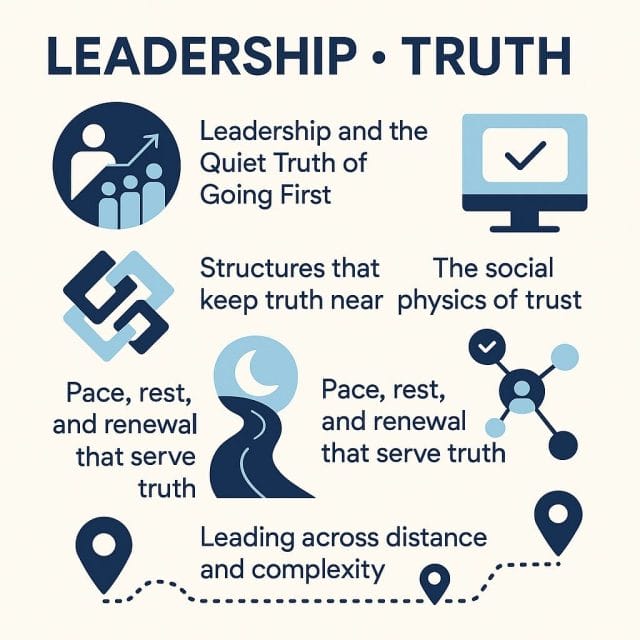
Structures that keep truth near
Truth needs structures. Without structures, truth depends on personal bravery and random chance. Structures hold the practice of truth when the leader is away, when pressure rises, and when the team is tired. These structures are simple, visible, and light. They do not add ceremony for ceremony’s sake. They bring reality into the week, the meeting, the plan, and the celebration.
Rituals that surface reality
Rituals are the rhythms of the group. When the front designs rituals that surface reality, the week becomes a series of honest moments that guide motion. A ritual can be a five minute truth check at the start of a stand up. It can be a weekly note that names where reality has shifted and what we will do. It can be a monthly ask for one truth the leaders might not see. Rituals create psychological permission to name and act.
- Begin team sessions with a simple question: what is changing that we must notice today.
- End planning meetings by naming one assumption that could fail and how we will learn quickly.
- Host a rotating reality window where different people bring one piece of early evidence to the group.
- Publish a weekly direction plus truth note: one sentence of direction, one sentence of reality, one next step.
 ” alt=”
 ” style=”display: block; margin: 1em auto; width: 80%; max-width: 600px; height: auto; border: 1px solid #ddd;”>
The map and the ground
Every plan is a map. The ground is the lived experience of the work. Truth keeps the map connected to the ground. The front invites people who walk the ground to mark the map. When the map stops matching the ground, we redraw the map. This is not failure. It is maintenance. A map that pretends to be true after the world has moved is vanity. A map that is redrawn with care is a tool for navigators.
- Hold a monthly map and ground review with people from the scene, not only planners.
- Mark where the ground surprised us and what the map must change to honour it.
- Document a few rules of map repair: keep it small, keep it timely, keep it connected to purpose.
- Invite edits from edge time observers who see early signals.
Decision logs and public intent
Truth in decision making is enhanced by decision logs and public intent. A decision log is simple. We record what we chose, why we chose it, what we expected, and by when we will review. Public intent is the habit of explaining the why aloud. This helps others follow, critique, and improve future choices. It builds a field of shared understanding that allows peers to lead locally without waiting for permission.
- Record a short decision note with the question, the choice, the intent, two boundaries, and the next review date.
- Publish intent in team channels so others can align their moves.
- Invite light dissent within a timeframe before the choice is locked.
- Return to the log after the review window and capture what we learned for future teams.
Feedback that is lived, not performed
Feedback culture often fails because feedback feels like inspection. Truth needs feedback that is lived. It arrives during work, close to the moment, and in language that names what happened and what could be better. The front models this by giving small, specific notes and asking for them in return. Performance reviews then become summaries of many small truthful notes rather than rare official events stacked with anxiety.
- Practice micro feedback: two sentences that name what worked and one request for change.
- Ask for a small note after a session so you are fully part of the learning loop.
- Keep feedback attached to observable behaviour, not identity or intention.
- Review feedback in a weekly window so it does not drift into folklore.
The social physics of trust
Trust is social physics. It is the predictable motion of people in relation to signals of care, competence, and consistency. The front influences these motions with visible behaviour rather than slogans. Truth and trust rise together. When truth is of high quality and regular frequency, trust increases because people feel their reality is seen and honoured. When truth is sporadic or manipulated, trust drains away and cynicism grows.
Repair as leadership
Mistakes do not kill trust. Failure to repair kills trust. Repair is a leadership craft. It begins by naming exactly what broke, apologising without qualification, and stating the repair plan and timeline. Repair continues through visible action and ends with an honest review of what changed and what will prevent a repeat. This craft creates a culture where it is safe to act because repair will be supported rather than punished. Risk is then taken responsibly for the mission rather than avoided for fear of judgement.
- Name the break without cushioning. This shows respect for those affected.
- Say sorry as a complete sentence, then state the repair and by when.
- Share interim updates even when the update is that work is ongoing.
- Close with a short lesson and a standard that upgrades the system.
Courage circles and peer authority
Truth becomes easier when courage is shared. Courage circles are small, regular sessions where peers bring a move they are nervous to make, describe the reality, and get practical support. Peer authority grows when the group sees people taking principled action and helping each other repair. This distributes the front across the organisation. Courage circles work because they reduce social risk and increase the quality of first moves, which amplifies trust.
- Keep the circle small, diverse, and regular. Predictability builds safety.
- Use a simple format: situation, intent, first move, help requested, next step.
- Rotate facilitation so authority is shared and skills spread.
- Track moves made and share results to create a visible record of courage.
” alt=” ” style=”display: block; margin: 1em auto; width: 80%; max-width: 600px; height: auto; border: 1px solid #ddd;”>
Pace, rest, and renewal that serve truth
Truth is not only a cognitive act. It is an energy act. People who are exhausted cannot sense early, cannot choose wisely, and cannot act with precision. The front must steward pace, rest, and renewal. Pace allows us to maintain honest motion. Rest allows us to reset our nervous systems and return to listening. Renewal allows us to bring fresh perception and creativity to hard problems. This is not indulgence. It is performance science.
Energy as a constraint
Energy is a constraint like budget and time. The front treats energy as a resource that must be measured and managed. This begins with noticing the team’s energy pattern across the week and month. Then we schedule demanding work when energy is highest and reserve lighter work for troughs. We protect slack because slack is the source of integration and insight. In slack, people connect dots and imagine better next steps.
- Track personal and team energy with a simple daily pulse and observe the pattern.
- Schedule high stakes sessions at energy peaks wherever possible.
- Design plateaus after sprints so recovery is real and not only symbolic.
- Guard slack as a formal part of the calendar. Make it visible and respected.
Ending things cleanly
Ending is part of truth. Unfinished work clutters the mind and drains energy. The front makes clean endings a craft. We decide to end a task, a project, or a relationship with care, we say so clearly, and we honour the effort. A clean ending clears space for new motion and prevents drift into half action. Culture shifts when endings are handled with respect and clarity. People learn that it is safe to stop, which increases the quality of starts.
- Name the ending decision early and explain the rationale and the care plan.
- Honour contributions and capture lessons in a short closure note.
- Remove artefacts that invite drift, such as old boards and stale documents.
- Mark the space as clear and state the next focus so energy moves forward.
Renewal rituals
Renewal rituals remind the group that we are living bodies, not machines. They can be simple and practical. A renewal ritual might be a weekly walk and talk to integrate the week’s learning. It might be a monthly hour where each person shares one thing that restored them and one insight that arrived because of rest. The front treats renewal as a skill that improves performance and truth sensing. Rested minds hear more of reality, and rested bodies feel more of the early signals that help a group move well.
- Schedule a regular integration hour that is protected from urgent work.
- Invite people to bring one renewing practice and teach it to others.
- Share how renewal improved a decision or revealed a signal we had missed.
- Connect renewal to purpose so it is not seen as escape but as preparation.
Leading across distance and complexity
Modern work often unfolds across distance. Truth must travel. The front designs signals and rhythms that maintain truth when we are not in the same room. Distance is not a reason to reduce quality. It is a reason to increase care in how we share reality, how we invite choice, and how we enable local fronts to act with confidence. Complexity increases the need for shared intent and light protocols that keep motion aligned without heavy control.
Front signals for distributed teams
Distributed teams need front signals that are clear and regular. These signals include a weekly intent broadcast, short decision notes, and visible feedback loops. People at the edge can then act with the same confidence as those near the centre. The leader is no longer the only front. Many fronts appear wherever the next honest decision is needed. This distribution reduces bottlenecks and increases the organisation’s response velocity.
- Publish a weekly intent note with context, direction, and the nearest right step.
- Keep a shared decision log accessible to all so choices are understood and can be referenced.
- Use short video or audio updates from the scene to make the work feel real across distance.
- Anchor remote sessions with a clear next step and a named owner for the first move.
Friction mapping and flow design
Truth in complex systems is revealed by friction mapping. We map where motion slows, where effort is wasted, and where the group feels confusion or repeated pain. The front leads a simple mapping session, uses a few symbols to mark friction, and then designs flow improvements that remove one friction at a time. Complexity is tamed by a series of small honest repairs rather than a single grand redesign. The team experiences momentum and believes change is real because friction visibly reduces.
- Host a friction map session with the people who touch the work daily.
- Mark recurring delays, unclear steps, and tools that resist instead of support.
- Choose one friction to remove this week and name the owner of the repair.
- Celebrate each flow improvement and record the before and after so learning compounds.
Time horizon alignment
Truth must be aligned across time horizons. The daily step must serve the monthly arc, which must serve the annual cause. The front keeps these horizons connected by repeating the why and showing how today’s action fits inside the longer view. When people see the thread, morale improves because effort feels meaningful. When horizons disconnect, confusion rises and people drift into activity that performs but does not progress the mission.
- Write a simple horizon map: today, this quarter, this year, and the purpose.
- Connect tasks to horizons in visible boards so people can see the thread.
- Review horizon fit in one short sentence at the end of key meetings.
- Adjust horizons when reality shifts and explain the changes as a matter of truth, not whim.
” alt=” ” style=”display: block; margin: 1em auto; width: 80%; max-width: 600px; height: auto; border: 1px solid #ddd;”>
Teaching others to stand ahead
Leadership that is honest is teachable. It is not a rare tone seen only in a few. The front crafts apprenticeships that develop the ability to sense early, choose direction under uncertainty, and transfer movement. Teaching is done in plain view through real work. We do not teach leadership with only theory. We teach it by standing together at the edge and making small moves that matter.
Apprenticeship at the front
An apprenticeship at the front pairs a learner with a leader during moments of first contact. They watch, they ask, they try a small move, and they receive honest feedback. Over time, the learner takes more first moves and the leader becomes a counsel rather than the necessary front. This spreads leadership and reduces the organisation’s dependence on a few individuals. The culture becomes resilient because many people can face reality and move responsibly.
- Identify real front moments and invite learners to shadow and then act.
- Explain decision logic out loud so the craft is visible and repeatable.
- Design safe to learn trials that let learners go first with contained risk.
- Review moves with a simple frame: what we saw, why we chose, what happened, what we will adjust.
The scaffolding of safe to learn
People learn faster when they know errors will be held with care. The scaffolding of safe to learn includes clear intent, bounded experiments, rapid feedback, and shared credit. Learners are also taught repair craft early so they do not fear error. Fear reduces learning speed and reduces truth telling. The front makes learning visible and normal. It is the main story when building new capability.
- State the learning goal and design the smallest test that teaches the most.
- Set boundaries that make errors containable and reversible.
- Give feedback within a day so learning compounds.
- Share credit for the attempt and refine the approach together.
Reward the attempt and refine the craft
Reward does not only follow success. It follows honest attempt. Teams that reward honest attempt while refining the craft produce more real success over time. People try more first moves, learn quickly, and discover better standards. The front makes this reward clear and consistent. It is not indulgence. It is practical encouragement that supports the mission by increasing the volume and quality of learning.
- Publicly recognise a first move that taught the team something new.
- Capture the lesson and turn it into an improved standard.
- Show the arc of craft improvement so people see progress over months.
- Maintain high standards while keeping the door open for brave attempts.
Integrity when it costs
Truth is most visible when it costs. A leader who stands ahead will face situations where the easiest path requires bending reality or ignoring inconvenient facts. Integrity is the choice to keep truth intact under pressure. This does not mean being harsh or inflexible. It means staying connected to purpose, values, and the living facts of the situation. Integrity protects the group’s long term coherence and reputation while serving the people affected today.
Scarcity and fairness
Scarcity brings hard choices. Fairness in scarcity is a test of truthfulness. The front names the scarcity, shows the criteria for choice, and applies those criteria with consistency. People will accept difficult outcomes more readily when the logic is clear, applied fairly, and connected to purpose. Fairness is not a perfect distribution. It is a principled process with clear communication and humane delivery.
- Describe the scarcity in plain language and how it arrived.
- Publish the criteria that will guide choices and invite quick feedback.
- Apply the criteria and document decisions in brief notes.
- Provide support for those most affected and monitor the impact over time.
Values under pressure
Values are not posters. They are behaviours under pressure. The front chooses values when it is costly to do so. This could mean declining a profitable deal that distorts the mission, protecting a colleague who named an uncomfortable truth, or refusing to manipulate numbers to satisfy a short term goal. Each of these choices signals to the group that our values are lived. Over time, the culture becomes predictable in the best sense. People know how we will act and can align their choices confidently.
- Collect stories of values lived and share them in regular sessions.
- Ask new joiners to describe a values moment they experienced and what they learned.
- Use values language in everyday meetings so it is part of normal speech.
- Invite gentle challenge when someone sees a drift away from values.
Saying no with clarity and care
Saying no is a truth skill. Many organisations suffer from unclear nos that appear as delay or avoidance. The front says no with clarity and care. We explain the reason, the boundary, and the alternative if one exists. We deliver the no early before others invest energy. We do not hide the no behind process. A clear no is a sign of respect. It prevents wasted effort and preserves trust because people know where they stand.
- Say no early and explain the reason connected to purpose and boundaries.
- Offer an alternative path or timing if one is honest and useful.
- Protect those affected by the no from negative social spillover.
- Record the no in decision logs so it is understood and can be revisited if reality changes.
Language that carries truth
Language is a vehicle for truth. It can carry reality, direction, and agency simply or it can obscure. The front uses language that is short, human, and useful. We prefer verbs that invite action and nouns that are concrete. We avoid vague abstractions and performative phrases. Clean language is a discipline. It takes practice to reduce sentences to their truth and still be generous and kind.
Simple frames for complex moments
In complex moments, use simple frames. A frame is a set of sentences that make the path legible without claiming absolute certainty. These frames gather facts, set direction, and invite participation. They also show humility by naming what we do not know yet and how we will learn. This combination of confidence and humility builds trust and unlocks motion.
- What changed, what it means, what we will do, and when we will review.
- What is true, where we are heading, and the first step you can take locally.
- What we are holding, what we are releasing, and what we expect to feel next.
- What we owe to customers, to colleagues, and to the mission in this moment.
Words that reduce social risk
Truth often stalls because social risk feels high. Words can reduce that risk. This does not mean avoiding the hard message. It means delivering it in ways that protect dignity and invite response. The front listens before declaring, names the behaviour not the person, and offers a path to restoration. People then feel strong enough to face facts because they are not being labelled or trapped.
- Use I saw and I felt followed by a question. This opens dialogue rather than a verdict.
- Say the impact in small clear terms so it is undeniable and actionable.
- Offer a next step that restores motion and confidence quickly.
- Thank the person for engaging even when the moment is uncomfortable.
When the path is rough
There will be rough paths. Markets change, systems fail, and human emotions run hot. The front moves toward the scene and holds the group together with honest presence. We do not perform calm. We practise calm by grounding in our bodies, using simple sentences, and making one correct next step. We respect the difficulty and we show that our values still apply. In rough paths, truth is a compass and an anchor.
Hold the scene with three sentences
In a rough moment, three sentences can hold the scene long enough to allow better decisions. We say what happened, what we are doing now, and when we will update. This reduces panic, prevents speculation, and creates a timeframe for reality to be refreshed. People then focus on their immediate task rather than spiralling inward or outward. The front repeats these sentences until new information arrives and adjusts them carefully.
- We name the event in plain language without blame.
- We state the current action that preserves safety or continuity.
- We set an update window and keep it even if the update is no significant change yet.
Use no drama and blameless review
No drama is a commitment to simple honest action. Blameless review is a commitment to learning without personal attack. Together, they form a practical culture for difficult moments. We act, we review, we repair, we upgrade standards. We do not perform heroics as a substitute for systemic improvement. Heroics are honoured and then converted into better systems so future people need less rescue.
- State the event factually and move to immediate action without performance.
- Hold a review that asks what happened, what signals were missed, and what will change.
- Upgrade one standard and one resource to reduce recurrence.
- Thank the people who held the line and show what changed because of their effort.
Return to pace and presence
After a rough path, return to sustainable pace and grounded presence. Adrenaline distorts truth sensing. It narrows attention and increases reactivity. The front models recovery by slowing breath, simplifying language, and focusing on one near step. Teams watch leaders more closely after difficult moments. If we return to healthy rhythm, they learn that we are not defined by crisis and that excellence is a daily practice.
- Pause for a short reset and invite others to do the same.
- State the next normal step clearly and proceed calmly.
- Clear small irritants that accumulated during the rough period.
- Recognise the emotional labour so people feel seen and can release tension.
Stewardship of culture through truth
Culture is the pattern of behaviour repeated and believed. The front is a steward of culture. Truth shapes culture more than any other element because it defines how we see the world and how we relate to one another. Culture stewardship is not an annual exercise. It is daily. It lives in where we place our attention, how we react to facts, and what we celebrate when no one is watching.
Attention as a cultural lever
Where leaders place attention becomes a cultural instruction. If attention is placed on early signals, small repairs, and honest attempts, the culture evolves toward reality contact and learning. If attention is placed on glossy outcomes and dramatic gestures, the culture evolves toward performance without substance. The front chooses what to attend to publicly. This choice teaches more than any statement.
- Attend to first steps that show alignment with direction and values.
- Attend to repairs that upgrade standards and reduce future pain.
- Attend to care acts that increase trust and resilience.
- Attend to small wins that prove progress is real and repeatable.
Celebration as reinforcement
Celebration is reinforcement. It tells the group which behaviours to repeat. Celebrate truth telling, clean endings, and responsible first moves. Celebrate integrity moments and courage circles. Celebration can be modest and frequent. It does not need to wait for a stage. A short note, a small gift, a shared meal, or a moment of public gratitude can be enough to signal that truth is valued and rewarded.
- Keep a weekly win ledger that includes truth acts and repair successes.
- Invite peer nominations for quiet acts of excellence and share them widely.
- Use celebration to connect people across domains so truth travels.
- Ensure celebration is fair and avoids creating an inner circle that distorts culture.
The front as a life practice
Standing ahead is not only a work practice. It is a way of living. People who practise front leadership tend to hold truth gently in personal life as well. They listen, they move toward difficult conversations, and they accept correction. They find that truth reduces unnecessary drama and increases intimacy and trust. The craft is the same. We ask what is real, what matters, and what is the next step. We share intent, we invite agency, and we repair when we fail.
Personal rhythms that support truth
Personal rhythms support truth in leadership. A daily clarity window, small journaling of decisions, and a brief counsel with a trusted peer can transform the quality of choices. Over time, these rhythms become scaffolding that protects against fatigue and distortion. We are then more available to others and more capable of sensing early. Personal discipline is not private vanity. It is public service.
- Hold a morning clarity window to connect with purpose and name the day’s direction.
- Maintain a light decision journal for pattern recognition and self correction.
- Build a personal counsel of two or three who will tell you the truth with care.
- Practice state resets so you can return to presence after disruption.
Truth and kindness together
Truth and kindness are not enemies. Truth without kindness can be cruel. Kindness without truth can be false. The front carries both. We speak with directness and care. We avoid the temptation to hedge so much that our message loses meaning. We also avoid the temptation to deliver a hard message without context or empathy. The aim is not to be right at any cost. The aim is to be helpful in service of the mission and the people.
- Prepare for hard conversations by writing one clear sentence and one care act.
- Use curiosity to open space rather than pushing a conclusion too early.
- Offer support after naming a truth so people feel accompanied.
- Review the conversation and ask what you could refine next time.
Closing: Keep moving with truth at the front
The front goes first. Truth is what the front meets. Leadership is the act of turning that meeting into motion. We sense early, we choose direction under uncertainty, and we transfer movement to others with care. We hold reality before reputation, we build structures that keep truth near, and we steward trust through repair and daily consistency. We tune pace for sustainable excellence, teach others to stand ahead, and hold integrity when it costs.
There is no need to wait for certainty or permission. The living body of the organisation is asking for movement. The next honest decision is asking for a front. Go to the edge where real work happens. Hear the faint signals, call what is true, and move one step that others can join. Publish intent, invite agency, and keep the feedback loop fast. Celebrate truth acts and clean endings. Use courage circles to share the load. Keep the map connected to the ground. Maintain the horizon thread so daily action feels meaningful.
If you fail, repair. If you succeed, teach. If you are unsure, design a small test and learn. Keep language simple and human. Keep values lived, not framed. Keep care and competence together. Keep consistency visible so trust can grow. Leadership is the front, and truth is the path. The rest is craft and practice, day after day, in service of a mission that deserves your honesty and motion.

If this article helped you in any way and you want to show your appreciation, I am more than happy to receive donations through PayPal. This will help me maintain and improve this website so I can help more people out there. Thank you for your help.
HELP OTHERS AND SHARE THIS ARTICLE
LEAVE A COMMENT

I am an entrepreneur based in Sydney Australia. I was born in Vietnam, grew up in Italy and currently residing in Australia. I started my first business venture Advertise Me from a random idea and have never looked back since. My passion is in the digital space, affiliate marketing, fitness and I launched several digital products. You will find these on the portfolio page.
I’ve decided to change from a Vegetarian to a Vegan diet and started a website called Veggie Meals.
I started this blog so I could leave a digital footprint of my random thoughts, ideas and life in general.
If any of the articles helped you in any way, please donate. Thank you for your help.
Affiliate Compensated: there are some articles with links to products or services that I may receive a commission.